
Originality And The Genuineness Of The Holy Qur’an In Its Text And Its Arrangement
By Hujjat ul-Islam Ayatullah Atlanta Hajj Mirza Mahdi Pooya Yazdi
The overwhelming majority of scholars of all schools of thought in Islam, agrees to the fact that the Holy Qur’an as it is now in our hands was rendered in writing under the command and the personal supervision of the Holy Prophet himself, and no addition, omission or alteration whatsoever ever took place in it. But there are a few traditionists of the Sunni as well as the Shi’a schools who influenced by the letter of the traditions more than reason and the historical facts, on account of some narrations, have held a different view that some omissions and alterations have taken place after the Holy Prophet before the official assent was given to the present version by the Third Caliph. The advocates of this view, never succeeded in establishing any doctrine to this effect. Their views remain as individual opinions with no following from anyone save the advocates themselves. Our attempt here is:
-
To point out the causes of the doubts.
-
To value the traditions forwarded in support of the doubts.
-
The Internal and the External evidence of historical value, for and against the views.
-
What the Muslims are demanded to believe about the Holy Qur’an from the religious point of view.
Before dealing with the subjects in detail under the above headings the following points have necessarily to be kept in view:
Qur’an - What It Means
By Qur’an we mean the verses, phrases, sentences and the chapters uttered by the Holy Prophet of Islam, not as his own wording but as the Word and the Book of God, revealed to him and which he proclaimed as his Everlasting Miracle which bears the testimony of his Prophethood and with which he challenged not only those who doubted its origin and not only mankind alone but even the Jinns saying that even if the Jinns and men join hands with each other to produce the like of it, they will never be able to do it even in a part of it. This challenge he threw not to any particular age but for all times. By this definition we exclude all the utterances of the Holy Prophet which he did not claim that the wording is of God (though the idea or the subject-matter was nothing but a revelation from God).
The definition also excludes the utterances of the Holy Prophet which he presented to the people as the Word of God but not as a miracle or a part of it with which he challenged the world (viz. the various Ahadith al-Qudsi). These Ahadith al-Qudsi are so numerous and abundant that if they are collected together, they will not be less than the size of the Holy Qur’an if not more, but their value in no respect or aspect, is more than the other genuine traditions of the Holy Prophet. This definition needs to be kept in view throughout the discussion about the Holy Qur’an.
-
Of the religious records of historical value, pre-Islamic or post-Islamic, in our hands, no document can ever compete with the Holy Qur’an in authenticity and genuineness. The historical records which the Muslims claim to be the most authentic and genuine of the Sunni school viz., the ‘‘Sihah al-Sitta” and of the Shi’a school viz., the Kutub al-Arba’a, none can claim of having the popularity and of being within the reach of every Muslim from his earliest age to his death in any degree as was the Holy Qur’an and no tradition was considered so important as to make every Muslim child, learn, recite and memorise it, word by word with utmost grammatical correctness and. phonetic perfection, as the Holy Qur’an.
-
This importance and care attached to the Holy Qur’an by every Muslim, was not the event of any later period. The Muslims were attracted to the Holy Qur’an, as the Word of God from the time of its revelation to the Holy Prophet and its recitation to the people. The Holy Qur’an itself from the time of its revelation encouraged the people in various ways to learn, read, recite and to memorise it and to ponder over every word of it and to mindfully listen to it when it is recited. When one recites it, one should first get ready to do it by disassociating oneself from anything and everything which would cause the least diversion of thought or the distraction of attention1.
-
The Holy Prophet was commanded by God not to be in a hurry in the recitation or in the arrangement of the Holy Qur’an but to follow the divine order in both respects (This indicates that the arrangement is not to be according to the date of the revelation). In short, the student of the Holy Qur’an will realise the amount of importance and care which has been attached to the Holy Qur’an by its Author and as a natural consequence of it, the Muslims who rightly believe that God is the Author of the Holy Qur’an, paid the utmost devotion to the Holy Book and carried out the orders as required of them. They learn and make their children learn it and put it into writing. In short, the Muslims in the lifetime of the Holy Prophet were taught and educated that to learn the Holy Qur’an is ‘Ibadat’ (Devotion); to recite it is ‘Ibadat’; to write it down is ‘Ibadat’; to teach others and make them read and learn it by heart and understand it is ‘Ibadat’; and to use the verses of the Holy Qur’an in the daily life to the extent that history records people never having used any other verse or phrase or sentence in their life but the Holy Qur’an.
The Holy Qur’an declares the teachings of the Book (the Divine Book) and the art of writing as one of the main objects of the advent of the Holy Prophet and considers the pen as the means of educating man even if the teacher is gone. The Holy Qur’an commands the people in their business transactions to write down their agreement and keep witnesses over it to avoid doubts and disputes later on. Is it possible that the Author of the Holy Qur’an who attaches so much importance to our writing down the affairs of our business, did not care for His own work, Himself attaching so much importance to it, which He produced as the Book containing the fundamental principles of the true, the divine, the universal and the Final message, not for any section of humanity or for any limited time but for the human race as a whole, for all times in all parts of the earth?
The authenticity and the genuineness of the version of the Holy Qur’an now in our hands and its being the same as the Qur’an uttered by the Holy Prophet, is so evident and obvious in certitude that no Muslim scholar of any standard has ever doubted the genuineness of this version that it includes any letter, word, sentence, verse, or chapter which was not uttered by the Holy Prophet as the part of the Qur’an. In other words, whatever we have in our hands, is Qur’an. The dispute is about omissions and alterations in the arrangement and some lettering and not about any additions at all (the alterations or the alternatives given by some commentators regarding some lettering, pronunciation and some words of the Holy Book which do not affect any substantial change either in the meaning or the significance of the phrases or the sentences). This will be dealt with under the variety of the recitations of the same words: viz., ‘Malika’ - ’Maalika.’ In short, the Muslim World throughout the ages has been unanimous that nothing has been added to the Holy Qur’an which is now in our hands.
All religious records other than the Holy Qur’an, Islamic or non-Islamic are suspected of containing passages, paras and even chapters to have been added to the Original Work.
Having in view this incompatible authenticity and the genuineness of the Holy Qur’an, in part as well as in whole, the Holy Prophet of Islam and his companions, the scholars in the subsequent generations are unanimous that the Holy Qur’an is to be taken as the standard and the criterion for the verification of all the other religious records be they Islamic or non- Islamic. Any narration, attributing any utterance, action, or endorsement, to the Holy Prophet or the Holy Imams of his House, which disagrees with the Holy Qur’an is to be considered as spurious and be rejected. This has been declared by the Holy Prophet, Ali, Hasan, and Husayn and the succeeding nine Imams of the Holy House, which means that Qur’an as the standard and the criterion for the verification of falsehood and truth in other statements and narrations did exist within the reach of the public throughout the ages down to 260 A.H.
There is no doubt that the Qur’an in our hands is the same as the version which received the official assent of the Third Caliph. All that has been said about the omission or any substantial alteration to have taken place in the Qur’an, is in the arrangement or the wording of the verses or the chapters which concerns the period after the departure of the Holy Prophet before the official assent of the Third Caliph given to the present version.
As already pointed out, the Holy Qur’an was current, in use during the lifetime of the Holy Prophet among the Muslims in the whole of the Muslim World with a vehement desire on the part of both the men and the women believers and even children who were anxious to own it by all means possible, in writing and mostly by heart. There were also the chosen scholars among the early Muslims whom the Holy Prophet had entrusted the duty of recording the Qur’an as it was revealed and recited by him then and there. The foremost of them was Ali Ibn Abi Talib, Ja’far Ibn Abi Talib and besides Ali were Abdullah Ibn Mas’ood and Mas’ab Ibn Omair of the earliest Muslims in Mecca and Obai Ibn Ka’b among the earliest adherents in Madina, (i.e., Ansars) Ma’az Ibn Jabal, Salim Maula Hazaifa and also the others. Ja’far Ibn Abi Talib was the head of the early Muslims who had migrated to Abyssinia, and he was the master of the Qur’an revealed up to date - and Mas’ab Ibn Omair was sent to Madina to teach Qur’an to the people before the migration of the Holy Prophet to the place.
These people used to record the Qur’an in writing under the direct command and the personal supervision of the Holy Prophet, in his very presence, then and there as it was revealed, putting each part of it in its relevant place as commanded by the Holy Prophet, and recite their manuscripts to him then and there and earn his approval, and also many times afterwards, and these scribes were considered to be in charge of teaching the Qur’an to the others. They were considered as the masters and the teachers of the Holy Book from whom the Muslims directly or indirectly learnt the Qur’an during the lifetime of the Holy Prophet and thereafter. These people and thousands of the prominent companions (Sahabas) who were interested in learning the Holy Qur’an and its commentary, and their disciples like Abdullah Ibn Abbas and the others, all lived throughout the intermediary period between the departure of the Holy Prophet from this world and the award of the official assent by the Third Caliph to the present version and taught the Muslims throughout the length and breadth of the fast-expanding Muslim Empire. And the people of the various races, creeds and different shades of opinion had learnt it by heart and taken it down in writing for their own use. It is enough to estimate the popularity of the Qur’an among the Muslims that it is said that in the one single battle of ‘Yamama’ which took place only about six months after the departure of the Holy Prophet, seven hundred ‘Huffaz’ (those who know by heart) were killed in a single day’s fight.
Qur’an was existing during the lifetime of the Holy Prophet in the form of an arranged Book as approved by the Holy Prophet himself. From the saying of the Holy Prophet that “Gabriel would place before me, Qur’an for review once a year but this year he did it Twice which indicates that the time of my departure is close at hand” It is quite evident that the divine Author and the Holy Prophet both have guarded the Qur’an so much that no adulteration of any kind whatsoever shall take place thereafter by any profane hand and that the Qur’an received its complete arrangement and order not later than about three months before the departure of the Holy Prophet. It is with reference to this revealed Book which existed in the complete form, within the reach of the people that the Holy Prophet addressing his followers declared: “I leave amongst you Two Great Things, the Book of God and my Ahl Al-Bayt”
And it was with reference to the Complete Book of God, in the hands of the Muslims at the time of the departure of the Holy Prophet that ‘Umar dared to reply against the demand from the Holy Prophet for paper and ink, ‘Hasbona Kitab Allah’, i.e., sufficient is for us the Book of God. This clearly and doubtlessly proves that a version of the Qur’an in its complete and duly arranged form, was existing among the people, within the reach of the common man, as were the Ahl Al-Bayt who were left by the Holy Prophet with the Qur’an, as otherwise all these references to the Book of God become meaningless.
The Holy Qur’an claims for itself a pre-arranged existence with God (in the ‘Lauhe Mahfooz’, the Secured Tablet) and the ‘Kitab al-Maknoon’, i.e., the Hidden Book for the believer or at least in the mind of the Holy Prophet for the disbelievers. The arrangement of the revealed form should be in accordance with the pre-revealed arrangement and not in accordance with the order or the date of its revelation, because circumstances may necessitate an earlier recitation of a portion or a verse or a chapter which might be the next in the order of the pre-revealed arrangement. In this case the post-revealed arrangement should be in accordance with the pre-revealed order and not in accordance with the date of the revelation. For instance, a well- versed poet or a prose writer who has arranged his lyrics or articles in his mind but circumstances force him to recite certain portions from two lyrics of different metres, but when he wants to put it in writing, the line of each lyric will go to the respective lyrics of the metres, irrespective of the date of the recitation.
Although there is no problem of any theological value, theoretical or practical which Qur’an has not dealt with and it surpasses all scriptural records of pre-Islamic or post-Islamic ages, in the abundant variety of it contents, yet its method of approach, presentation and solution is exclusively unique to itself. It never deals with any topic in a systematic way used by ordinary authors of theology or even by any apostolic writers, on the contrary it expressively says that it has adopted a special method of its own, of changing the topics and shifting from one subject to another or reverting to the previous one and repeating deliberately and purposefully one and the same subject to facilitate understanding, learning, and remembering it vide:
وَلَقَدْ صَرَّفْنَا لِلنَّاسِ فِي هَٰذَا الْقُرْآنِ مِنْ كُلِّ مَثَلٍ فَأَبَىٰ أَكْثَرُ النَّاسِ إِلَّا كُفُورًا
“And certainly, We have used various arguments for men in this Qur’an, every kind of description, but most men consent not to aught but denying” (17:89).
وَلَقَدْ صَرَّفْنَاهُ بَيْنَهُمْ لِيَذَّكَّرُوا فَأَبَىٰ أَكْثَرُ النَّاسِ إِلَّا كُفُورًا
“And certainly, We have repeated (the verses) to them that they may be mindful, but the greater number of men consent not to aught but denying” (25:50).
قُلْ أَرَأَيْتُمْ إِنْ أَخَذَ اللَّهُ سَمْعَكُمْ وَأَبْصَارَكُمْ وَخَتَمَ عَلَىٰ قُلُوبِكُمْ مَنْ إِلَٰهٌ غَيْرُ اللَّهِ يَأْتِيكُمْ بِهِ انْظُرْ كَيْفَ نُصَرِّفُ الْآيَاتِ ثُمَّ هُمْ يَصْدِفُونَ
“Say! Have ye considered that if God taketh away your hearing and your sight and setteth a seal on your heart, who is the god besides God that can bring it to you? See how We repeat the verses, yet they turn away” (6:46).
قُلْ هُوَ الْقَادِرُ عَلَىٰ أَنْ يَبْعَثَ عَلَيْكُمْ عَذَابًا مِنْ فَوْقِكُمْ أَوْ مِنْ تَحْتِ أَرْجُلِكُمْ أَوْ يَلْبِسَكُمْ شِيَعًا وَيُذِيقَ بَعْضَكُمْ بَأْسَ بَعْضٍ انْظُرْ كَيْفَ نُصَرِّفُ الْآيَاتِ لَعَلَّهُمْ يَفْقَهُونَ
“Say! He hath the power that He should send on you chastisement from above you or from beneath your feet, or that He should throw you into confusion (making you) of different parties and make some of you taste the fighting of others. See how We repeat the verses that they may understand” (6:65).
The repetition is to variously show forth the signs (of the Unity of God).
From the following verse of the Holy Qur’an, it is quite obvious that the Holy Qur’an was already alive to the fact that this changing attitude will make some opponent of it, accuse its Author of getting its subject-matter from here and there. It is for this reason; it is said in this verse as in the other passages that it gives the reasons for its special or unique way or system of presentation:
وَكَذَٰلِكَ نُصَرِّفُ الْآيَاتِ وَلِيَقُولُوا دَرَسْتَ وَلِنُبَيِّنَهُ لِقَوْمٍ يَعْلَمُونَ
“And thus, do We (variously) repeat the verses and that they may say Thou hast learnt (them from others) and that We may make it clear to a people who know” (6:105).
However, it is a fact that the Holy Qur’an deals in each chapter of particular rhythm with various topics in various ways and this variety adds only to its unique beauty and matchess eloquence. Any attentive reciter or an intelligent audience of the Holy Qur’an, while passing through these varieties in one rhythmical pitch, will enjoy to the extent which the Holy Qur’an itself declares:
اللَّهُ نَزَّلَ أَحْسَنَ الْحَدِيثِ كِتَابًا مُتَشَابِهًا مَثَانِيَ تَقْشَعِرُّ مِنْهُ جُلُودُ الَّذِينَ يَخْشَوْنَ رَبَّهُمْ ثُمَّ تَلِينُ جُلُودُهُمْ وَقُلُوبُهُمْ إِلَىٰ ذِكْرِ اللَّهِ ذَٰلِكَ هُدَى اللَّهِ يَهْدِي بِهِ مَنْ يَشَاءُ وَمَنْ يُضْلِلِ اللَّهُ فَمَا لَهُ مِنْ هَادٍ
“God hath the best announcement, a Book comfortable in its various parts, repeating whereat do shudder the skins of those who fear their Lord, then their skins and their hearts become pliant to the remembrance of God; This is God’s guidance. He guideth with it whomsoever He willeth; and (as for) him whom God alloweth to err, there shall be no guide for him” (39:23).
أَفَمَنْ يَتَّقِي بِوَجْهِهِ سُوءَ الْعَذَابِ يَوْمَ الْقِيَامَةِ وَقِيلَ لِلظَّالِمِينَ ذُوقُوا مَا كُنْتُمْ تَكْسِبُونَ
“Is he then who has to guard himself with his own person against the evil chastisement on the Resurrection Day? And it will be said to the unjust: ‘‘Taste ye what ye earned”“ (39:24).
كَذَّبَ الَّذِينَ مِنْ قَبْلِهِمْ فَأَتَاهُمُ الْعَذَابُ مِنْ حَيْثُ لَا يَشْعُرُونَ
“Those before them rejected (the apostles) therefore there came unto them the chastisement from whence they perceived not” (39:25).
فَأَذَاقَهُمُ اللَّهُ الْخِزْيَ فِي الْحَيَاةِ الدُّنْيَا وَلَعَذَابُ الْآخِرَةِ أَكْبَرُ لَوْ كَانُوا يَعْلَمُونَ
“So, God made them taste the disgrace in this world’s life, and certainly the chastisement of the hereafter is greater; if they only know (it)!” (39:26).
وَلَقَدْ ضَرَبْنَا لِلنَّاسِ فِي هَٰذَا الْقُرْآنِ مِنْ كُلِّ مَثَلٍ لَعَلَّهُمْ يَتَذَكَّرُونَ
“And certainly, We have set forth for men in this Qur’an similitudes of every sort that they may mind” (39:27).
قُرْآنًا عَرَبِيًّا غَيْرَ ذِي عِوَجٍ لَعَلَّهُمْ يَتَّقُونَ
“An Arabic Qur’an without any crookedness that they may (guard) against evil” (39:28).
ضَرَبَ اللَّهُ مَثَلًا رَجُلًا فِيهِ شُرَكَاءُ مُتَشَاكِسُونَ وَرَجُلًا سَلَمًا لِرَجُلٍ هَلْ يَسْتَوِيَانِ مَثَلًا الْحَمْدُ لِلَّهِ بَلْ أَكْثَرُهُمْ لَا يَعْلَمُونَ
“God setteth forth a parable; there is a man in whom are (several) partners differing with one another, and there is another man (devoted) wholly to a man. Are they two alike in condition? (All) praise is God’s; nay! most of them know not” (39:29).
Even those who doubted the genuineness of the arrangement of the present version did not claim that the whole arrangement of the verses, in all the chapters have been affected. There are chapters which were undoubtedly revealed in complete form viz., Chapter 54, 55, 56 and the chapters immediately preceding and succeeding them. One will find the same variation of subject, is manifested in those chapters. This variety of expression in rhythmical way, is found not only in the chapters but even in the verses of the Holy Book. These are the facts an intelligent and a sincere student of the Holy Qur’an, will realise more and more in going through this Holy Book repeatedly.
The Causes Of The Doubts
There is no doubt that the irresistible fascinating force and the challenging power of the Holy Qur’an were the main, if not the sole means of conversion ever since the start of the Holy Prophet’s mission. Irrefutably the recital of the Qur’an, the opponents did not spare any effort to prevent the Holy Prophet and his disciples reciting the Qur’an before the public, and to obstruct people, particularly the youth among them, from listening to it. There is abundant historical evidence vouching this fact. Besides this preventive measure the opponents tried also to overcome the irresistible force and the wonderful effect of the recital of the Holy Qur’an by’ trying to disturb its recital by adulterating it by interjections:
وَقَالَ الَّذِينَ كَفَرُوا لَا تَسْمَعُوا لِهَٰذَا الْقُرْآنِ وَالْغَوْا فِيهِ لَعَلَّكُمْ تَغْلِبُونَ
“And those who disbelieve say: ‘Listen ye not to this Qur’an and make noise therein’” (41:26).
As one of the consequences of this effort is the story of ‘‘Tilkal Ghurani ol ola inna shafaatahunna laturja’ to the effect that when the Holy Prophet while reciting Sura 53 (Wan-Najm - the Star) reached the verse 20, one of the infidels among the audience uttered this passage of his own as the continuation of the verse recited by the Holy Prophet, adulterating the language and disturbing the sequence of the succeeding verses. The result was that the infidels immediately fell into prostration as the token of their approval and satisfaction. This shows that there was a pre-arranged plan among the infidels to disturb the recital of the Qur’an by the Holy Prophet which incident was condemned by the Qur’an as an unsuccessful satanic attempt which was made against all the preceding prophets also when they used to deliver God’s message to the people2.
وَمَا أَرْسَلْنَا مِنْ قَبْلِكَ مِنْ رَسُولٍ وَلَا نَبِيٍّ إِلَّا إِذَا تَمَنَّىٰ أَلْقَى الشَّيْطَانُ فِي أُمْنِيَّتِهِ فَيَنْسَخُ اللَّهُ مَا يُلْقِي الشَّيْطَانُ ثُمَّ يُحْكِمُ اللَّهُ آيَاتِهِ وَاللَّهُ عَلِيمٌ حَكِيمٌ
“And We sent not before thee any apostle or prophet but when he recited (Our message) reading of the devil made his (interrupting) desire in (between) the recital; but God annulleth that which the devil casteth; then God doth establish his signs and God is All-Knowing, All-Wise” (22:52)
لِيَجْعَلَ مَا يُلْقِي الشَّيْطَانُ فِتْنَةً لِلَّذِينَ فِي قُلُوبِهِمْ مَرَضٌ وَالْقَاسِيَةِ قُلُوبُهُمْ وَإِنَّ الظَّالِمِينَ لَفِي شِقَاقٍ بَعِيدٍ
“So that He may make what the devil casteth a trial for those in whose hearts is disease and those whose hearts are hard, and verily the unjust are in a great opposition” (22:53)
وَلِيَعْلَمَ الَّذِينَ أُوتُوا الْعِلْمَ أَنَّهُ الْحَقُّ مِنْ رَبِّكَ فَيُؤْمِنُوا بِهِ فَتُخْبِتَ لَهُ قُلُوبُهُمْ وَإِنَّ اللَّهَ لَهَادِ الَّذِينَ آمَنُوا إِلَىٰ صِرَاطٍ مُسْتَقِيمٍ
“And that those who have been given the knowledge may know that it is the truth from thy Lord, so they may believe in it and their hearts may be lowly before it; and verily God is the Guide, of those who believe, towards the right path” (22:54)
It is surprising that some critics3 and some ignorant commentators of the Holy Qur’an accepting the rumours spread by the infidels and the hypocrites of the later period attribute the satanic utterance of the infidels to the Holy Prophet himself, while the internal evidence of Sura. 53 itself, i.e., the preceding and succeeding verses to verse 20, makes such an utterance by the Holy’ Prophet as impossible. However, this hostile attitude towards the Holy’ Qur’an though unsuccessful, continued by the external and the internal enemies and the critics of Islam. The hypocrites during the lifetime of the Holy Prophet as well as afterwards, did not hesitate to divert the attention of the Muslims from the Qur’an or weaken its influence on the minds of the people by all possible means.
With the above background, the unnecessary, the unwarranted and the unauthorised attempt of the immediate ruling party to make a collection of the Qur’an of their own, apart from the then current collection already prepared under the supervision and instructions of the Holy Prophet by the scribes who were put in charge of recording in writing the Qur’an then and there as it was revealed, with the commentary from the Holy Prophet. The First Caliph on the advice of the Second, entrusted Zaid Ibn Sabit with the task, who was a youth of no experience or standing in comparison to the official scribes appointed by the Holy Prophet viz., Abdullah Ibn Mas’ood and Obai Ibn Ka’b besides Ali Ibn Abi Talib who was the foremost and topmost of all in all aspects of knowledge of the letter as well as the significance and the implications of the Holy Qur’an.
The incompetency of Zaid Ibn Sabit concerning Qur’an in comparison to the other scribes is evident from the remarks of Obai Ibn Ka’b when a dispute arose between the two, about the recital of a certain passage of the Qur’an:
“Thou teacheth me Qur’an? While I was reading the Qur’an with the Holy Prophet while thou were yet a child playing in the streets”
A similar remark was passed by the same Obai Ibn Ka’b against the Second Caliph when they disputed on another point concerning the Qur’an. Obai told the Second Caliph:
“I used to read Qur’an with the Holy Prophet while you were yet busy in your transactions in the Bazaar”
Neither Zaid nor ‘Umar dared to refute the claim of Obai. In this attempt Zaid Ibn Sabit had to refer to the ordinary people who possessed some scattered portions of the Qur’an either in writing or in memory, and not to the acknowledged authorities mentioned above. Unfortunately, neither the First nor the Second Caliph was, in any degree, an authority on Qur’an for there are authentic evidence of their ignorance of it, in the matters of the administration of the State4.
Not only Zaid had no academic qualifications for the task of compiling the Qur’an but the dispute between him and the Second Caliph during his reign, proves the lack of regard of the Two for the revelation: Tn this dispute the Second Caliph wanted something from Zaid who declined to comply with the order. The Second Caliph said:
“Look! It is my command and not the revelation with which you could play”
It shows that none of the two bothered much in playing with the revelation if his desire was to be served.
However, as history says, they attempted the collection of Qur’an in this manner, and something was collected but was not published and remained as a bundle with Ayesha or Hafsa under their beds. Of the Muslims, none had any approach to it, but it is also said that a goat devoured a portion of the collection. The anecdote is a further testimony to the lack of regard for their collection, on the part of those who patronised it. The reign of the first two Caliphs passed away and the bundle of the collection remained where it was left years ago. But Qur’an was being written, taught, learnt, memorised, recited, discussed, and applied in the daily life of the Muslims throughout the fast-expanding vast Muslim Empire.
It has been vouched by the Second Caliph that even the ladies had a knowledge of the Qur’an more than those at the helm of the administration of the Muslim Empire. No Muslim complained against the lack of approach to the collection by Zaid, nor did anyone ask the State to publish the bundle. The teachers of the Qur’an were performing their duties directly and through their disciples throughout the Muslim World independent of the bundle in the possession of the State. The first half of the reign of the Third Caliph also passed away when a variety in the recitation of Qur’an was noticed among the Muslim soldiers who were fighting with the infidels on the remote borders of the Empire. This worried Hudhayfa al-Yamani one of the most trusted confidants and a prominent disciple of the Holy Prophet who had a complete list of the hypocrites. He advised the Third Caliph as a precaution to unify Muslims under the current recitation of the Qur’an as that of the Holy Prophet himself and stop people using the recitations of their own choice, so that later it may not lead to any diversities.
The Third Caliph again entrusted the job to the same Zaid and Zaid did nothing but what Hudhayfa had suggested and got it adopted as the official version to which the Third Caliph gave his assent, and several copies of that official version were made and despatched to the different parts of the empire so that the people may revise their versions accordingly. No complaint of any omission, addition or alteration was made by anyone either to the Caliph or to his party, nor even the opponent party who were framing charge after charge of the deviation from the right path, against the Third Caliph, ever complained regarding this. The Third Caliph was blamed for ordering the other versions, differing from the official version in recitation, to be burnt or destroyed as an act of desecration of the Word of God. But none charged him with the adulteration of the matter of the Qur’an. In spite of the utmost care taken by the ruling party for publication of the official version and the obliteration of the other versions, they did not succeed, and all the ether current recitations have come down to us in the terms of the seven or the ten recitations. The Omayyid rulers could not stop the publication of the other recitations, how could they or any other power on earth have stopped the publication or the narration of the verses or the chapters left out of the Qur’an if there were any or stop recording the objections to the additions or the disarrangement if there had been any.
The presence of the seven or the ten varieties of the recitation and the absence of any copy, record, or narration of a different version of the Holy Book after the publication of the received version, is the best and the greatest proof of the genuineness of the received version. We shall deal with this subject in further detail in the text when the occasion demands it. But this attempt along with the unwarranted utterances attributed to the members of the ruling party before the official assent was given to the received version, gave the chance to the opponents of the Qur’an whether in the garb of Muslims or otherwise who could not disturb the miraculous force of the eloquence of the Qur’an, by throwing some vain in it to spread the rumours about the incompleteness and the disarrangement of the received version. And these rumours gained currency along with the development of the later religious and political diversities. And in spite of the efforts of the Holy Imams of the House of the Holy Prophet and the faithful thinkers of the scholarly academic accomplishment, these rumours got somehow their way into the books of traditions first of the Sunni School and consequently the Shi’a books of tradition also are not exempted from the taint of such sceptic rumours. The result was that some of the traditionists of both the schools who lack the strictness of the scrutiny of the authenticity and the proper examining of the external and the internal evidence for and against the text or the wording of the traditions, accepted these rumours in the face of the indisputably established genuineness of the Holy Qur’an.
Another reason for the rise of these doubts was the traditions which assert that the collection of Qur’an by Ali being in a particular form and the same is said about the copies of Abdullah Ibn Mas’ood and Obai Ibn Ka’b. There are different versions about the collection of Ali; whether he refused to place his collection at the disposal of the ruling party and the public or the ruling party refrained to accept it when it was offered, and whether this happened in the reign of the First or the Second Caliph is also a matter of doubt for ‘‘Al-Majlisi’ narrates that it was during the reign of the Second Caliph, while the others say it was during the time of the First Caliph. In any case the collection, if any, remained with him and his successors in the office of ‘Imamah’, beyond the reach of the public and nobody has claimed to have seen that collection thoroughly or copied it except one or two traditionists who claim that the Sixth Holy Imam Ja’far Ibn Muhammad showed them the collection and allowed them to have a glimpse of it, and in one small Sura were found seventy names of ‘Munafiqa? (hypocrites) and this is contradictory to what Ali had declared about his collection that none will see it before the Last Imam appears and the tradition itself says that the Sixth Imam gave the collection to the narrator concerned and told him not to look at it, but the traditionist disobeyed the Imam and opened it and had a glimpse of the Sura, the story looks to be absurd why the Imam handed over a thing to one, and how he could entrust it to a person who would disobey him. And it is said that Ali’s Qur’an contained all that was revealed and as it was revealed, with its exertic...and assertic.... interpretations.
Apart from the question of the authenticity of these traditions and the contradictions in their texts with each other, a thorough examination of them will prove beyond doubt that the collection in question was a sort of a fully detailed commentary on Qur’an which contained the revelations and their interpretations besides the text. It was not only the miraculous text which was placed within the reach of mankind as a challenge. The same is the case with the other collections of Abdullah Ibn Mas’ood and Obai Ibn Ka’b and the others, who, being the acknowledged and the authorised earliest students of the Qur’an, they must have had their own special collection of the interpretation and their own notes for their own information and guidance, in which case they might have also a different arrangement of the verses and the chapters for their commentary purposes, as the later commentators have done it (chronological and subject wise etc.). These collections cannot have anything to do with the current received version placed as an open challenge within the reach of the common man.
The commentary nature of the collection of the imminent companions of the Holy Prophet is obvious from such traditions which say that Abdullah Ibn Mas’ood would recite with the verse of ‘Mut’a’ (temporary marriage) the phrase ‘ila ajalin’ (until a term) after 8 ‘Famastamta tumbihi minhunna’... (when you commit ‘Mut’a’ (temporary marriage) with them). It is obvious that this phrase was used by him as an explanatory note of guidance and of protest when ‘Mut’a’ (temporary marriage) was prohibited by the Second Caliph; or the narration which says that Ibn Abbas used to recite ‘Fi Aliyin’ (about Ali) after ‘Maonzila ilaik’ (that which has already been sent unto thee) in verse 5:67 just as an explanatory note to the occasion and the implicative significance of the revelation when the people were neglecting it; or in the verse ‘Inna Allaha astafa Aadama wa Noohan…’(3:33) according to some traditions Ibn Abbas had added ‘Aala Muhammad’ (the descendants of Muhammad) after ‘Aala Imran’ or had replaced ‘Aala Imran’ by ‘Aala Muhammad’. If this tradition is true, Abdullah Ibn Abbas might have said that ‘‘Aula Muhammad’ are meant here but not as the wording of the Qur’an because if it is taken as the wording of Qur’an ‘Dhurriyatun Ba’zuhu min Ba’z’ Ali will be out of ‘Aale Muhammad’ and if it is said without ‘Dhurriyatun Ba’zuhu..’ people other than the House of the Holy Prophet would be included in the ‘Aal” (descendants) in the same way as all the followers of Pharaoh are included in ‘Aale Fir’awn.’
In short, the existence of the different collections of the Qur’an by different companions of the Holy Prophet which were never published or gained any currency among the Muslims, in part or in whole, cannot have any value more than that of a tradition serving as a commentary on the text. And this is the reason that none of those of the acknowledged and authorised students of the Holy Book, raised any voice of dissent at all against the received version though all of them were alive and had their own complaints and grievances of other religious importance against the ruling party. They complained against the Third Caliph only because of the burning of some copies of the Qur’an as an act of desecration of the Holy Book.
Thus, the causes of the doubts were:
-
The unwarranted, unauthorised, and unnecessary attempt of the First Caliph and his party for the collection of a Qur’an of their own.
-
The unwarranted and irresponsible utterances of some members of the ruling party about the incompleteness of their own collection.
-
The said existence of a special collection of Qur’an by AU, complete in all aspects and respects.
-
The unsuccessful attempt of the Third Caliph to stop the other seven or ten recitations of the Qur’an except that of the official version by burning and destroying some copies of the Qur’an with the other recitations.
-
The system of dotting and the introducing of the vowel signs and the other marks for the correct pronunciation of the wording of the Qur’an by Hajjaj Ibn Yousuf about the close of the first century A.H. the purpose of which was to guard the recitation of the Qur’an against its mispronunciation by the non-Arabs.
-
The above five causes gave room and opportunity to the enemies of Islam, external as well as internal, to criticise the genuineness and the authenticity of the Qur’an, when they failed to resist the miraculous force and the wonderful effect of its recital, by adulterating its text by their own interceptions and they got the opportunity also to make false narrations about the omission and the alteration of certain verses of the Qur’an here and there.
Though all the above questions have been dealt with in brief, let us examine a few references given by the traditionists which have somehow found their way into the books of traditions of both the Sunni and the Shi’a Schools.
Regarding the first attempt of the ruling party for having a collection of their own, Bokhari narrates from Zaid Ibn Thabit that after the battle of Yamama the First Caliph sent for Zaid and told him in the presence of ‘Umar that he (‘Umar) had come to him, telling that many reciters of Qur’an have been killed in the battle of Yamama and he was afraid of the other reciters also being killed in the other battles resulting in the loss of a great portion of the Qur’an. He (‘Umar) had told the First Caliph ‘I see that you should order the collection of Qur’an’. I told ‘Umar ‘How could I do what the Holy Prophet did not’; to which ‘Umar replied, ‘By God I swear, this is good to be done,’ and ‘Umar continued demanding of this from me till God opened my heart for it (a claim for a sort of inspiration). Zaid says that the first Caliph told me ‘You are an intelligent young man whom we do not suspect, and you used to write the revelations for the Holy Prophet. You search for the Qur’an and collect it.’
Zaid says ‘I swear on my God, if they had ordered me to carry out the task of shifting a mountain from its place, I would not have felt it so heavy a task as what they had asked me to undertake (i.e., the collection of the Qur’an). I said, ‘How dare you do a thing which the Holy Prophet did not?’ The First Caliph said: ‘By God I swear! it is good to be done.’ ‘Thereafter the first Caliph continued asking me to undertake the task till God opened my heart for what He had opened the heart of the First Caliph and ‘Umar.’ ‘Therefore, I carried the search for the Qur’an, collecting it from the pieces of wood, bones and from the memory of the people till I found the last verse or the Sura al-Tauba with Abi Khozaima al-Ansari and with no one else.’ This collection remained with the First Caliph till he passed away, then with ‘Umar and then with his daughter Hafsa.
Bokhari tells us that Hudhayfa Ibn al-Yaman on his return from the expedition to Armenia and Azerbaijan, expressed his anxiety about the variation among the members of the expedition in the recitation of the Qur’an and asked the Third Caliph to take the necessary steps to unite the Muslims in this regard before it leads to a controversy about the Book of God in the manner of the controversies of the jews and the Christians about their Holy Scripture (as there even today exist the various versions of the Old and New Testaments termed as the apocryphal ones against the Bible termed as authentic). Then the Third Caliph asked ‘Umar’s daughter Hafsa to hand over the bundle of the collection of the Qur’an left with her so that copies of it may be made. The Third Caliph ordered Zaid, Abdullah Ibn Zobair, Sayeed Ibn al-Aas and Abdur-Rahman Ibn Harith Ibn Hisham to prepare copies of it. The Third Caliph told the three Qurayshites that whatever you and Zaid differ in the recitation of Qur’an and in its pronunciation, write it in accordance with the dialect of the Quraish as it was revealed in their dialect. They did as they were bidden and prepared copies of the collection and returned the original to Hafsa and sent the copies to all corners of the empire, and the Third Caliph ordered Qur’an in any other booklet form or in the form of any collection to be burnt and destroyed. In continuation of these statements Bokhari narrates from the son of Zaid that he had heard his father telling ‘When we were copying the collection, we missed a verse from Sura al-Ahzab which I used to hear the Holy Prophet reciting it and then we searched for it and we found it with Khozaimat Ibn Thabith Ansari, then we put it in the same Sura in the collection.’
These two traditions of Bokhari regarding the collection of the reign of the First Caliph and the copying of it during the reign of the Third Caliph contains a slight contradiction regarding the missing verse of Qur’an which could not be found with anybody except one Abu Khozaimat Ibn Thabith Ansari.
Now besides these Two, there are twenty more traditions regarding this collection of Qur’an, each contradicting the other in some way or other. Eleven of them are mentioned in the ‘Muntakhab al-Kanz ul-Ummal’ and the rest have been taken from Itqan of Suyooti etc. The following is the brief account of them:
In one tradition Ibn Abi Shaiba narrates from Ali that he said that Abu Bakr is the greatest person regarding the collection of the Qur’an. He is the first person who collected the Qur’an which is between the pads.
Another narration also says that Abu Bakr collected the Qur’an on paper and asked Zaid Ibn Thabit to review it which Zaid declined to do, and Abu Bakr sought the help of ‘Umar to persuade Zaid and he did it and that reviewed copy remained with Abu Bakr, then with ‘Umar and then with Hafsa.
A third tradition from Hisam Ibn Orwa asserts that after the battle of Yamama wherein some of the companions of the Holy Prophet who had collected the Qur’an were killed, Abu Bakr ordered ‘Umar and Zaid Ibn Thabit to sit at the gate of the Mosque and collect Qur’an from the people.
Another tradition from Muhammad Ibn Seereen tells us that ‘Umar was killed, and Qur’an was not yet then collected.
A fifth tradition says that once ‘Umar asked for some verse of the Holy Qur’an, and he was told that it was with some person who was killed in the battle of Yamama. ‘Umar got much worried and ordered Qur’an to be collected and he was the first person to collect the Qur’an in a book form.
A sixth tradition tells us that ‘Umar decided to collect Qur’an and ordered that ‘whosoever has received from the Holy Prophet any portion of the Holy Qur’an, should bring it to us’ and the people had the Qur’an on bits of wood, stones, skin, leaves of trees and bones and he would not accept anything from anyone unless it was certified by two witnesses, and he (‘Umar) was killed while the collection was yet going on. Then Othman succeeding him, continued the task and repeated the order of ‘Umar and demanded two witnesses to accept anything. Then Khozaimat Ibn Thabit came with the last two verses of the Sura al-Bar’at saying that ‘I have received it from the Holy Prophet, and you have not got it in your Qur’an!’ Then Othman said ‘Yes! I also give evidence that these verses are from God, but tell me where we should place them?’ Abu Khozaimat said, ‘Place these two verses at the end of the last revealed portion of the Qur’an’ and they were accordingly placed at the end of the Sura al-Bar’at concluding the sura with it.
The seventh tradition asserts that it was ‘Umar who accepted these last verses of the Sura al-Bar’at from a man of the Ansars without any witnesses, against his own condition for the acceptance which he had previously fixed.
The eighth tradition says that after the battle of Yamama in which four hundred or seven hundred reciters of Qur’an were killed, Zaid Ibn Thabit approached ‘Umar and said that ‘Qur’an is the only unifying factor of our religion and if it is lost our religion is also lost. I have decided to collect it in a book form,’ to which ‘Umar replied, ‘Wait till I ask Abu Bakr’ and both went to Abu Bakr and informed him of their talk. Abu Bakr replied ‘Do not hurry until I consult the Muslims’ and then he began lecturing to the people informing them of their decision. All approved of it. Then they collected the Qur’an and Abu Bakr ordered a crier to announce that whosoever has a part or the whole of the Qur’an should bring it.
A ninth tradition narrates that Khozaima Ibn Thabit said that he brought the last verses of Sura al-Tauba to ‘Umar and Zaid Ibn Thabit. Then Zaid asked Khozaima as to who would give evidence in his support to which Khozaima replied that he did not know anyone. Then ‘Umar said that he was there to witness it.
The tenth tradition says that when ‘Umar collected Qur’an, he asked ‘Who is the best in pronunciation?’ The people said ‘Syeed Ibn al- Aas,’ and then ‘Umar asked, ‘Who is the best calligrapher?’ The people said Zaid Ibn Thabit. Then he said, ‘Let Syeed dictate, and Zaid write.’ They made four copies, one was sent to Kufa, one to Basra, one to Damascus and one to Hjaz.
The eleventh tradition reports that when ‘Umar wanted to write the Leading Qur’an, he made a few of his companions undertake the task and said, ‘Wherever you differ in the wording write it down in the dialect of Mozar, for Qur’an was revealed to a man of Mozar.’
The twelfth tradition reports the narration of Abu Qullaba that during the reign of Othman the teachers of Qur’an started teaching their pupils different recitations and the boys used to meet and differ from each other. This was brought to the notice of the teachers and the result was that they condemned each other’s recitation. The news reached Othman and he gave a lecture saying ‘You people differ in the recitation and recite it in my presence. What about those who are far away from me in distant cities. Their recitation would differ greater and ever greater.’ Then he addressed the companions of the Holy Prophet ordering them to write a Leading Qur’an for the people. Abu Qullaba narrates that Malik Ibn Anas has said that he was among those who used to dictate the Qur’an and they used to mention the name of the person who had received that verse from the Holy Prophet and if the person was not present, they used to write the preceding and the succeeding verses leaving blank the space for the verse under dispute, until the person concerned was available. And Othman completed the Collection and wrote to the people in the big cities that he had obliterated what was with him and they should also act accordingly.
The thirteenth tradition relates that Othman addressed the people in one of his lectures and said, ‘Only thirteen years have passed between you and your Prophet, and you doubt in the Qur’an, saying the recitation of Obai or the recitation of Ibn Mas’ood and one tells the other that his recitation will not stand right.’ Then he urged them all by an oath to the effect that whosoever had any portion of the Qur’an should bring it. People brought pieces of paper, bits of wood and skin etc., containing Qur’an on them till a great number was collected. Then Othman went inside (his house) and called them one after another and made each one swears that he had heard it from the Holy Prophet and that the Holy Prophet had dictated it to him. After finishing this he asked as to who the best in pronunciation was; the people said ‘Syeed Ibn al- Aas’. Then he ordered Syeed to dictate and Zaid Ibn Thabit to write. Several copies were made and were distributed among the people and the narrator (Mas’ab Ibn Sa’b) says that he heard some of the companions of the Holy Prophet approving this act of Othman.
The fourteenth tradition tells us about the persons who were ordered by Othman to make the collection. The dictator was from the Tribe of ‘Hozail’ and the scribe from the tribe of ‘Thaqeef’.
A fifteenth tradition relates that after the collection was completed, it was brought to Othman who looked at it and said ‘You have done well and done the best. Yet I see some mistakes which the Arab would correct it, by his own tongue.’
The sixteenth tradition relates that when the collection was shown to Othman and he found some mistakes therein, he said ‘Had the dictator been from the ‘Hozails’ and the scribe from the ‘Thaqeefs’ these mistakes would not have taken place.’
A seventeenth tradition reports that when Othman wanted to make copies of the Qur’an, he sent for Obai Ibn Ka’b who dictated to Zaid Ibn Thabit and Zaid wrote it down and Syeed Ibn al- Aas was there to correct the pronunciation. Thus, the Qur’an of Othman was the recitation of Obai and Zaid.
The eighteenth tradition supports the seventeenth one but adds a person named Abdur- Rahman Ibn al- Harith to assist Syeed Ibn al- Aas in correcting the pronunciation.
The nineteenth tradition narrates from Zaid Ibn Thabit that while they were making the copies of the Qur’an, he found the passage 33:23 of Sura al-Ahzab missing and he found it with Khozaimat Ibn Thabit only, whose lonely evidence was accepted by the Holy Prophet as the evidence of two.
The twentieth one of the traditions tells us that the first person who collected the Qur’an was Abu Bakr, and Zaid Ibn Thabit was the scribe, and people would come to Zaid with passages and he would not accept any passage unless it was supported by at least two pious men except in the case of the last passage of the Sura al-Bar’at which was found with Abu Khozaimat Ibn Thabit whose lonely evidence was taken as two by the Holy Prophet, and that ‘Umar brought the passage concerning the stoning of the adulterers and we did not accept it from him for he was alone without anyone to witness.
These are the main reports about the venture of the collection of the Qur’an by the ruling party during the reigns of the first three Caliphs. None of these has the degree of authenticity to make one certain of its genuineness. Besides, they are subject to criticism from various aspects.
Let us first examine the first two traditions on the authority of Bokhari:
-
Supposing that Qur’an was not collected and arranged in a book form during the lifetime of the Holy Prophet, what right could anyone have to do it according to one’s own taste or fancy? Is it a sort of innovation? What does ‘Sharh as-Sadr’ (The opening of the heart) mean? Does it mean a sort of inspiration or revelation which the Christians claim for the authors of the Gospels? Can this ‘Sharh as-Sadr’ be taken as an authorised legal source like ‘Kitab’ and ‘Sunna’ (the Book and the Tradition) of the Islamic Jurisprudence and the means of inference of ‘‘Halal’ (the allowed) and the ‘Haram’ (the prohibited)? Or was it an exclusive privilege given only to these three (Abu Bakr, ‘Umar, and Zaid Ibn Thabit)? That about the other companions of the Holy Prophet who had also made the collection which fact has been unanimously acknowledged by the Muslim World?
-
Why did then Othman destroy the other collections with no sanction by the Holy Prophet for his action? Zaid’s collection as well as the collection of the others according to this statement were based on their ijtihad. Then why should one ijtihad be preferred to the other?
-
Why was Zaid’s inspired collection not immediately published and placed within the reach of the people before giving any room for the other versions of the Qur’an to get the currency they had gained in the length and breadth of the Muslim Empire, which forced Othman to destroy them after about twenty years of their currency?
-
What does the wording of Abu Bakr to Zaid imply?
“You are a young intelligent youth whom we do not suspect, and you used to write the revelations for the Holy Prophet.’
What was the qualification of Zaid which made them prefer him to the other scribes who had the honour of writing the revelations since its earliest days and long long before Zaid grew from his childhood? On the contrary the experience of a ripe age was actually the need. What does the clause ‘we do not suspect you’ imply? Leave away Ali Ibn Abi Talib who was certified by the Holy Prophet as the one who will always be with the Qur’an and with whom will always be the Holy Book and besides the other innumerable number of the certifications which he held from God and the Holy Prophet - who was the person identified with the Holy Prophet and the Holy Prophet identified with him - i.e., ‘Aliyyun Minni wa ana min Ali’ (Ali is of me and I am of Ali) - who was identified as the ‘Nafs’ or the soul of the Holy Prophet on the occasion of the historic ‘Mubahila’ - about whom the Holy Prophet had declared ‘Ana wa Ali min Noorin Wahid’ (I and Ali are of one and the same Light) - who was next only to the Holy Prophet meant by the verse of ‘Tatheer’ - who was declared by the Holy Prophet to be always with the truth and truth to be always with him - who was the foremost of the ‘Itrafe’. the Ahl Al-Bayt along with whom the ‘Kitab Allah’ the Book of God, the Holy Qur’an, was left among the ‘Ummat’ (the Muslims) as the Two Inseparable entities of the highest value for the guidance of the ‘Ummate Muslima’, i.e., the Muslim nation as a whole - who in relation to the Holy Prophet, was termed by the Holy Prophet as Aaron was to Moses with the exception of ‘Nubuwaat’ (apostleship) - -Who was certified by the Holy Prophet as ‘The Gate of the City of Knowledge and Wisdom’ - ’The Best Judge and the Witness of Truth’ not only to the Holy Prophet - These and the innumerable other qualifications - because it may be said as Bokhari and Muslim report through Malik Ibn Aas Ibn al- Hassan that the ruling party believed that Ali had no good opinion of them, and that he at that time was not on good terms with them, what about Abdullah Ibn Mas’ood, Obai Ibn Ka’b, Ma’aaz Ibn Jabal and Saalim Maula Abi Hudhayfa whose authorities according to Bokhari were certified by the Holy Prophet who had ordered the people to receive the Qur’an from the above four persons. This is narrated by Abdullah Ibn ‘Umar. Of course, Saalim was killed in the Battle of Yamama but the other three were alive and were available till the official version of Othman was issued by him, but no reference was ever made to any of these persons - Why? During the reign of Othman, the assistance of certain Omayyid youths such as Syeed Ibn al- Aas and Abdur- Rahman Ibn al- Haris Ibn al- Hisham was sought while the persons like Abdullah Ibn Mas’ood and Obai Ibn Ka’b were ignored. Was it because they suspected them and if so, of what? Was it:
-
The lack of the knowledge of the Qur’an’’
-
The lack of truthfulness and reliability?
-
The lack of political loyalty to the ruling party?
-
In view of the certification of the Holy Prophet, the first two possibilities are to be entirely discarded. Now remains the third possibility which is a historic fact that these were not loyal to the ruling party as Zaid Ibn Thabit was, as Ibn Abdul-Bir (the author of Istee’aab) tells us that he (Zaid) remained pro-Othman and pro-Omayyid and never joined hands with the opposition and for this act of loyalty on his part, he was rewarded with wealth and comfort while the persons like Abdullah Ibn Mas’ood and Obai Ibn Ka’b suffered the disfavour and particularly the former suffered persecution also by the ruling party. And if these were the reasons for ignoring these people then the bonafide of the attempt itself to collect the Qur’an become subject of suspicion.
-
Moreover, these two traditions of Bokhari contain contradictory statements regarding the missing verse of the Qur’an which was not found with anyone except the one whose name in one tradition is given as Abi Khozaima al-Ansari and in the other tradition as Khozaimat Ibn Thabit al-Ansari. Regarding the passage itself, in the first tradition, it is said that it was the last verses of Sura al-Bar’at and in the second it is given as verse 33:23.
Of the other twenty traditions given above, the First and the Second tell us that Abu Bakr was the first person who collected the Qur’an and according to the Second, Zaid Ibn Thabit was asked only to review Abu Bakr’s collection, contradicting the previous tradition which says that it was Zaid who collected it at the order of Abu Bakr.
The Third one says that ‘Umar and Zaid were given jointly the task of the collection and here it is said that some companions of the Holy Prophet who had already collected the Qur’an, were killed in the battle of Yamama. History is made silent about what happened to these collections and why they were not sought by the ruling party so seriously interested in collection of the Qur’an. And this contradicts the two previous traditions and the two previous to them, as it asserts that others had already collected the Qur’an.
The Fourth one contradicts all the other traditions that ‘Umar was killed, and Qur’an was not then collected.
The Fifth gives an entirely different story that ‘Umar was the first person who ordered the Qur’an to be collected in a book form and the reason was that he asked about some passage of the Qur’an and was told that it was with a person who was killed in the battle of Yamama, which means that the collection of Qur’an took place during the reign of ‘Umar long after the battle of Yamama.
The Sixth one gives us quite a different picture saying that it was ‘Umar who decided to collect the Qur’an in the same process of collecting it from bones, leaves, bits of wood and paper etc., with the witnesses, but the work was not yet completed when he was killed and Othman pursued the same course and he was the one who supported the statement of Khozaimat Ibn Thabit and not ‘Umar, while the Seventh tradition says that it happened in the reign of ‘Umar and he accepted the verses from a person who had brought them, without asking for any witnesses.
The Eighth tradition gives the credit of the initiative and the decision to collect the Qur’an by Zaid Ibn Thabit during the reign of Abu Bakr, and Abu Bakr did not approve the proposal of Zaid supported by ‘Umar, till he consulted a crowd of the Muslims and obtained their approval after which he ordered the collection.
The Ninth makes Othman and Zaid Ibn Thabit, the joint champions of the cause of the venture of the collection of the Qur’an and ‘Umar accepted the statement of Khozaimat Ibn Thabit, without any evidence, offering himself as a witness to it.
The Tenth asserts ‘Umar as the initiator of the collection and employed Syeed Ibn al- Aas as the dictator and Zaid Ibn Thabit as the calligrapher and they produced four copies which were despatched to the big cities mentioned in the tradition. This contradicts the first two traditions of Bokhari which date the initiative to the collection in the reign of Abu Bakr and the despatch of the prepared copies to the big cities during the reign of Othman and it contradicts the traditions which give the credit of the initiative to ‘Umar and of the completion to Othman.
The Eleventh wants to confer the honour of the writing of the Leading Qur’an on ‘Umar.
The Twelfth gives the credit of the initiation of the collection and its completion and the preparation of the copies to Othman and introduces Anas Ibn Malik as one of the dictators of the Qur’an while it was being copied. Further, it asserts that Othman informed the people of the big cities about what he had done with the Qur’an and ordered them to follow his footsteps, without sending any copies to them, which clearly indicates that Othman was sure of the people already having the copies of Qur’an with them. It shows that of the various recitations the most current was that of Abdullah Ibn Mas’ood and Obai Ibn Ka’b.
And the Thirteenth one asserts Syeed Ibnul Aas as the dictator and Zaid Ibn Thabit as the calligrapher who produced the copies which were distributed to the people.
The Fourteenth one asserts that the task of the dictation and of writing of the Qur’an was given by Othman to persons of the ‘Hozails’ and ‘Thaqeefs’ and not to Syeed Ibn al- Aas and Zaid Ibn Thabit, the first of whom was an Omavi and the second one an Ansari, while the sixteenth one says that if the dictator and the calligrapher had been of the ‘Hozails’ and the ‘Thaqeefs’ mistakes found by Othman in the prepared copies would not have taken place, which clearly indicates that the ‘Hozails’ and the ‘Thaqeefs’ were never at all employed in copying the Qur’an.
The Fifteenth and the Sixteenth state that the prepared copy was not free from mistakes, and they were left to the tongue of the arabs, and no corrections were made.
In the Sixteenth and the Eighteenth traditions, the name of Obai Ibn Ka’b is mentioned as a dictator and Zaid Ibn Thabit as the calligrapher which contradicts the statement of the Thirteenth which presents Syeed Ibn al-Aas as the dictator and it also contradicts all the traditions which present Zaid Ibn Thabit as the solely responsible person who undertook the job.
The Nineteenth and the Twentieth contradict each other about the missing passage which was found with Khozaimat Ibn Thabit. The first one says it was the verse 33:23 and the other says that it was the last verse of Sura al-Bar’at.
All these contradictory and inconsistent statements if they are not the creation or the innovations of later periods, show’ that in order to counter the credit and certification given by the Holy Prophet to Ali and the other members of the Ahl Al-Bayt and to Abdullah Ibn Mas’ood, Obai Ibn Ka’b, Ma’aaz Ibn Jabal and Saaleem as the highest accredited authorities on Qur’an, an attempt was made by the ruling party to produce the collection of Qur’an of their own and dispense with these authorities all together and thus to obtain a new credit for themselves. But they differed even among themselves as to whom the credit should go more. So, parties within parties counter to each other had obviously been formed, each party trying its best to own the credit for its own group and its hero. The only thing which can be said is that whoever be the hero in this venture, he was neither competent nor authorised for the task. And thus, though they had collected something of the scattered fragments from here and there, yet they dared not publish it for more than about twenty years during which period Qur’an had gained a tremendous currency in a perfect book form throughout the length and breadth of the vast Muslim Empire, and was taught, learnt, memorised, and acted upon in the daily life of the people and justice was being meted out according to it.
As Othman and the ruling party of his time felt their failure in their attempt to gain any credit in this regard through their instituted venture, procured a copy of the current version and gave the official assent to it and called it the official version. The absence of the so called collection of Abu Bakr which was laid to rest with ‘Umar and after him with his daughter Hafsa, the so-called collection of ‘Umar and the so called collection of Othman and the total absence of any other collection by anyone else and the absence of any objection by the opposition, to the assented version is the best and the greatest and the irrefutable testimony to the fact that the received version or the assented copy had continued to be the same since the departure of the Holy Prophet about which the Holy Prophet had declared:
“I leave amongst you the Book of God and my Ahl Al-Bayt”
And that whatever has been uttered contradictory to this, is nothing but a fabrication of wishful thinking which has no value, validity, or authenticity of any degree at all. It only throws light on the fact that among the companions there were people who attempted to discredit the received version by spreading rumours to feed a disruptive and mischievous propaganda.
In support of the fact, we will quote some of the statements attributed to some prominent members of the ruling party about the omissions in the present version.
The first and the foremost of all, what is agreed by the majority of the Sunni school of thought about some passages of the Qur’an, there are certain passages the wording of which is abrogated but their contents or the instructions which were accommodated therein remained valid. The example given of such abrogation is the passage dealing with the stoning of the adulterers - the wording of which is given in three different forms as Bokhari and Muslim narrate on the authority of Ibn Abbas from ‘Umar.
And Muslim tells us that Ayesha said that of the revealed passages of the Qur’an there were two passages dealing with the number of feedings by a foster mother to make her prohibited or to be considered as the mother of the baby. Ayesha says that in the first passage there was given as ten definite feedings and it was abrogated by another passage which reduced the number to five definite feedings and these two passages were read as a part of the Qur’an till the departure of the Holy Prophet. This is given as an instance of the abrogation of the passages in both the respects, i.e., the wording as well as the instruction implied in it. But a careful examination of these two instances prove that the abrogation is a sugar-coated term which meant only the omission because none, but the Holy Prophet had any right of abrogating anything from the Qur’an, either any wording or any significance of any contents. It is obvious from the two statements that the abrogation had not been done by the Holy Prophet as the first statement says that ‘Umar brought the passage dealing with the stoning of the adulterers while they were collecting the Qur’an, they did not accept it from him not for the reason of its being abrogated but for the want of the requisite witness to support the statement of ‘Umar. In the second one Ayesha expressively says that the passages dealing with the fostering mother were the part of the Qur’an till the departure of the Holy Prophet. Therefore, if these statements are true, it means nothing but the intentional omission of certain passages of the Qur’an by an unauthorised people.
Suyuti in his Itqan in continuation of the narration of Bokhari and Muslim regarding this matter, relates from ‘Umar another passage which is said to be missing in the received version of the Qur’an. But a proper examination of the said missing passages which ‘Umar and Ayesha present, comparing them with the style of the Qur’an, it proves beyond doubt that they can never be a part of the Qur’an and they are nothing but some personal fancies, for this is nothing new for the companions used to accuse each other of such mistakes of their fancies in their narrations in the question of the mourning for a bereaved person and Ayesha accused ‘Umar of misunderstanding the statement of the Holy Prophet regarding the mourning for a departed person. It is impossible that a part of the Qur’an should be unknown to all the companions of the Holy Prophet except Ayesha and ‘Umar, both of whom were accused of forgetfulness and lack of the knowledge of Qur’an.
Itqan on the authority of Tibrani narrates that ‘Umar said that the Qur’an contained ten lakhs twenty-seven thousand letters whereas the Qur’an available in his time would not reach even one third of the quantity, which means that more than two-thirds of the Qur’an has been omitted. A question arises when the Qur’an according to ‘Umar and the ruling party was yet to be collected even until the end of his life, how were the letters of the book as a whole counted? Even so when he was intimately acquainted with the present one third portion of it and a multitude of the other Muslims had even memorised it.
Moreover, when he was the person whose evidence even for one verse which he so well remembered was not accepted by his own party while Khozaima’s statement was accepted without any testimony from anyone else, how can his solitary statement about the missing of the two- thirds of the Qur’an be accepted of which he could neither remember nor even mention a single verse.
Itqan tells us that Abdullah Ibn ‘Umar said that someone may say he has received the whole Qur’an but what does he know about the whole? But one should only say that he has received of the Qur’an only that which has been known to evidence. Again, Itqan says that Ayesha claimed that the Sura al-Ahzab read during the time of the Holy Prophet contained 200 verses and that in Othman’s collection we find much less. To this same effect ‘Muntakhabet Khanz nl Ummal’ narrates from Obai Ibn Ka’b that he said that the Sura al-Ahzab which now contains seventy-three verses, was originally equal in size to the Sura al-Baqara or even more.
He is the person whom Obai Ibn Ka’b discredited in the matter of Qur’an as a person who was busy in his transactions in the Market while Obai and others were busy studying Qur’an under the Holy Prophet. And in another dispute regarding the status of Ansar as equal to the MoHajjr or subordinate to them, ‘Umar quoted verse 100 of Chapter 9 omitting the conjunctive letter, between Ansar and the relative pronoun (Those who follow them) rendering the adjectival clause after to qualify Ansar the result of which the Ansar should follow the Muhajirs, Obai Ibn Ka’b refuted ‘Umar’s misreading by asserting the conjunctive letter, between Ansar and the relative pronoun in which case the Ansars’ status becomes equal to the Muhajirin and the relative pronoun becomes a term of reference to those who follow the Muhajirs and Ansars afterwards. And this was a matter of great political importance which discards the claim of the Quraysh to be superior to the Ansar. Nevertheless, Obai’s authority on Qur’an was accepted and ‘Umar withdrew his misquotation.
Ayesha’s evidence for the missing of 127 verses of Sura al-Ahzab without quoting even a single verse of it, should be discredited as she did not remember even the beginning words of the verse 33 of the same sura which concerns herself as well as the other wives of the Holy Prophet. And the statement attributed to Obai Ibn Ka’b is also to be dismissed because the omission of such a large portion of one particular sura without being remembered by him as an acknowledged authority on Qur’an and none else besides him remembering anything of such a large quantity of the matter, is unbelievable and such an utterly discreditable claim could never have come from a personality like Obai Ibn Ka’b.
Another tradition of Itqan which asserts that Ayesha had a collection of her own, a lady narrating from her father that in Sura al-Ahzab after ‘Tasleema’. of the verse 56 of ‘Salawat’ there was a conjunctive clause... ‘wa alallazina yasiloona sofooful awwal’... and that was before Othman’s making changes in the collection. First of all the internal evidence against this statement is the style of the alleged missing clause which is against the unanimous verdict of the Muslims as a whole because either Muslims in their ‘Salawat’... on the Holy Prophet stop with the Holy Prophet or join his family to it or go further and add the companions in general or the wives and the issues of the Holy Prophet furthermore. But there is no trace of any evidence in support of this suffix. Thirdly, nobody else has narrated that Ayesha’s ‘Mus’haf’ (here own collection) was ever destroyed by anyone. Therefore, the question arises as to what has happened to that ‘Mus’haf’
Another tradition of Sahih Muslim says that Abu Musa al-Ash’ari called the reciters of Qur’an in Basra and people who had studied Qur’an came to him. He addressed them saying:
“You are the chosen ones of the people of Basra and their reciters of the Qur’an - You continue reciting Qur’an regularly and do not leave it away for any long time lest your hearts might get hardened in the manner of the hearts of the previous people and he said me used, to read a sura in Qur’an which would resemble in length and rigidity to Sura al-Bar’at, but I have forgotten it except one verse of it.
and there was another Sura which resembled to one of the ‘Musabbihat but that also I have forgotten except one verse of it, which runs as follows……..”
The style of both the quotations of Abu Musa, is entirely inferior to that of the Qur’an and the wording of the first passage itself, makes it quite obvious that it belongs to the category of the ‘Ahadith al-Qudsi’ the definition of which has already been given in the very beginning of this topic.
And regarding the Second, it might be taken as a parenthetical sentence in the form of commentary added to the text of the verse 61:2 before the third verse (Kabora maqtan indallahe) .... of the same chapter, which Abu Musa having heard it, might have taken it to be a different sura, because he is known to be credulous and weak in memory and lacking the literary taste, and as he himself confesses to have forgotten both the suras and none else had any knowledge of the matter, this statement is automatically discredited. Besides, the statement, if it be true, might have been made after the start of the tension between him and Othman which led to his removal from the governorship Thus, it is obvious he wanted to blackmail Othman accusing him with the omission.
Suyuti in his Itqan tells us that once ‘Umar told Abdur Rahman Ibn Auf: ‘Don’t you find this passage among what was revealed to us ‘In jahado kama juhadtum awwala marratin’. ‘Surely we do not find it now!’ to which Abdur Rahman replied that it was one of the passages of the Qur’an which was omitted. First of all this is a conditional clause, a part of the larger one. The consequent sentence is not mentioned and neither ‘Umar nor Abdur- Rahman Ibn Auf mention that it was the part of which verse of which sura it is, it shows the failure of this man... .Secondly, who prevented ‘Umar to reinsert this and the other omitted passages into their respective appropriate places in the Qur’an as he was a powerful leader of the ruling party unless it is said that these passages and the many other passages which were fancied by persons like ‘Umar and Abdur Rahman as the parts of the Qur’an, were the matters rejected by the Muslims for the lack of the Internal and the External evidence in support of the statements.
Similar to this sort of statement is what Suyuti tells us in his Itqan about the statement of Muslimat Ibn Mukhallad Ansari, a prominent companion of the Holy Prophet that once he asked the people, among whom there was also Sa’aad Ibn Malik Ansari... ‘Will you tell me about the two passages of the Qur’an which were not written in the collection?’ to which none replied excepting his son (most probably Muhammad Ibn Muslima) who recited the passage.
A proper examination of this passage will prove beyond doubt that the reciter had confused certain passages of different suras of the Qur’an with each other and inserting his own fancies in it and this throws light on the inimitable and the miraculous style of the Qur’an that whoever has attempted to imitate it, has exposed himself. Secondly, one can infer that the knowledge of Qur’an at that time was a great qualification of merit, credit, and honour.
Therefore, those who lacked it, tried to pose themselves as its students and the miraculous style of the Qur’an on one side and the lack of witnesses from the other betrayed them, as we today have among us incompetent and unqualified people who as the fashion of the day, pose themselves as great scholars in science and politics. It may be added to this category of tradition what is said about the two suras...found in the collection of Ibn Abbas and Obai Ibn Ka’b the proper examination of which bears testimony to the fact that their style is quite different from that of the Qur’an, and they may be classed under the category of the supplications (Adyiya - i.e. prayers) worded by the Holy Prophet or some member of his holy family. In the opinion of some, these two are even inferior in the language and the style of the supplications of the Imams of the Holy House of the Holy Prophet, the authentic collections of which we have in our hands.
There are some more traditions of this stuff which we need not worry ourselves with. What is given here is only ‘Mushti az Kharwar’ a handful from a heap. It is enough to have in view that Qur’an, to its credit has got internal evidence of its Inimitable Style which is exclusively peculiar to itself and the innumerable number of its external witnesses. All the verses and the suras, ever since its revelation have been placed within the reach of a group of people who had vehement zeal for hearing it, for writing, learning, understanding, memorising, and acting according to it. Not a single word or sentence or a passage can be accepted from the historical point of view, as a part of the Qur’an if it lacks the support of these two, external and the internal, evidence.
Therefore, for a student of the Qur’an it is easy to discard or discredit the traditions of these sorts, no matter whatever be the qualifications of the companions of the Holy Prophet as the reporters and the number of the subsequent reciters. But from these sorts of reports, we infer that either for blackmailing each other or for discrediting the received version of the Qur’an, which stood between them and their political aspirations and aims, some of the members of the ruling party were inclined to spread such disruptive rumours. On the other hand, those of the Ahl Al-Bayt and the people attached to them and other companions who were not attached very much to the ruling party, during this period never attacked or criticised the received version or even raised any voice of dissent against it. On the contrary they, in pursuance of the command of the Holy Prophet insisted on their opinion about the genuineness, validity and the authenticity of the received version as the standard and the criterion or the touchstone prescribed or fixed by the Holy Prophet for the verification or the test of the genuine and the false traditions both the pre-Qur’anic as well as the post-Qur’anic ones. The Holy Ahl Al-Bayt have recorded the saying of the Holy Prophet that once he (the Holy Prophet) stood up and declared, saying:
“Certainly, the liars on me have increased abundantly. Beware! For every truth there is a proof and for every Right there is the Light - Thus, whatsoever agrees with the Book of God hold it fast and whatsoever is opposed to the Book of God, leave it away”
The Holy Ahl Al-Bayt stuck up to this - Ali said the same - Hasan said the same - Husayn said the same and every one of the nine succeeding Imams succeeding Husayn have followed the same principle and their adherents stuck up to the same principle (see Al-Kafi and all the subsequent authorities on tradition). No tradition dealing either with the theory or the practice of Islam was, is and will ever be acceptable to the Imams of the Holy House of the Holy Prophet or the members of their school of thought, if it does not agree with the Book of God. As Allama Al-Majlisi has put it:
“Of the innumerable miracles of the Holy Prophet, the First and Foremost is the Holy Qur’an which is the most genuine and authentic one (narrated and recorded ever since its revelation by innumerable persons generation after generation down to ns) and will last as such till the day of Resurrection”5
Before concluding this chapter, it is desirable to forward more references to some traditions of the Sunni school about the nature of Ali’s collection of the Qur’an, the date of the collection, its authenticity and Ali’s knowledge of the inner and outer aspects of the Qur’an in its parts and its whole.
Suyuti in his Tarikhul Khulafa tells us - Ali is one of the godly scholars, the celebrated Warrior, the famous Ascetic, and the well-known Orator and one of those who collected the Qur’an and presented it to the Holy Prophet for his review. And in Itqan Suyuti on the authority of Abu Na’yeem, relates the statement of Ali himself:
“No verse of the Qur’an was revealed but I know about what and when it was”
And the same Abu Na’yeem narrates from Abdullah Ibn Mas’ood that Qur’an was revealed on seven folds or seven sides (Ahrof) or aspects, each of which has an inner and an outer significance and Ali Ibn Abi Talib has got with him all the inner and outer aspects with all the significance of each aspect.
The author of Waseelatun Najaat, Mullah Muhammad Mubeen Luckhnavi, on the authority of Ibn Seereen asserts that Ali arranged the Qur’an according to the dates of the revelation, with nothing antedated.
Again, Suyuti in his Itqan says, among those who arranged the Qur’an according to the dates of revelation, Ali is one.
And Abu Shukoor the author of Tamheed says that the companions of the Holy Prophet were not unanimous in accepting Ali’ collection.
Itqan of Suyuti says that Ali’s collection began with sura ‘Iqra’ ...and then ‘Almuddasir’ then ‘Muzzammil’...and then ‘Tabbat’ ...and then ‘Takweer’...and likewise. All the Meccan suras and then the Madinite suras, and Abdullah Ibn Mas’ood’s collection began with ‘Baqara’, then ‘Nisa’ ...and then ‘Aale Imran’ and with a lot of differences therein, and same was the case with the collection of Obai Ibn Ka’b.
These narrations and the others of the same sort, if we accept their authenticity, it will assert nothing more than what has already been said that Ali is the Foremost and the topmost one next only to the Holy Prophet in the thorough knowledge of the inner and outer significance of every word, sentence, passage, part or chapter of the Qur’an in its revealed and pre-revealed form to which the Qur’an itself bears testimony if it is properly and impartially read without any prejudice - verse 56:77-79 as the major premises, and verse 33:33 as the minor premises and Verse 3:61 as the conclusion defining the personnel of the Ahl Al-Bayt, adding to it the unanimous verdict of the Muslim World as a whole, as to the names of the persons whom the above verses were applied to. These verses supported by many other verses of the Qur’an which declare of the descendants of ‘Aale Ibrahim’... Those who were divinely made to inherit ‘Kitab’ (Book). ... ‘Hikmat’ ... (Wisdom) and ‘Mulke Azeem’ ... (the Great Kingdom) and the ‘Ohda al-Imamah’ (Office of Imamah) - are those who are the foremost in the total obedience and service to the Absolute, purified from all ungodly inclinations.
The topmost of whom the Ishmaelite branch, is the Holy Prophet himself and next to him are the members of his holy family (the Ahl Al-Bayt) headed by Ali as an Imam and succeeded by the eleven holy Imams. The inclusion of the Holy Lady Fatimah in the Ahl Al-Bayt besides her personal purity is by virtue of her three-sided position or status, being the Daughter of the Holy Prophet, the Wife of the First Holy Imam and the Mother of the Eleven Imams thus establishing the link between ‘Risalah,’ i.e., prophethood and ‘Imamah’ i.e., the Divine Guidance, a position or status which can never be secured by merely being a wife of a Prophet, playing no part in establishing the divinely chosen line of Abraham’s descendants.
This clear evidence of the Qur’an supported by the most authentic declarations of the Holy Prophet that:
-
“Ali is of me, and I am of Ali”
-
“Ali is with the Qur’an and Qur’an will be with Ali”
-
“Ali is with the Right and the Right will be with Ali”
-
“The Qur’an and the Ahl Al-Bayt are the Two Inseparable Entities, each perfect in itself reflecting the others” - (left behind among the people by the Holy Prophet for their guidance till the Day of Resurrection, assuring the Muslims of being safe from getting astray, should they stick up to these Two Inseparable Ones).
Regarding Ali’s and the others’ special collections, it has already been said that their particular arrangements must be for the commentary purposes or for the personal information and the guidance of the respective collectors themselves, or for the other academic purposes. Because there is abundant evidence of Ali’s collection and of those of the other authorised companions of the Holy Prophet viz., Abdullah Ibn Mas’ood and Obai Ibn Ka’b - contained some explanatory notes which must definitely be besides the text, and they never attempted to give any publicity at all to their notes against the received version of the Qur’an which is meant for all men for all times and as a challenge to be an everlasting miracle of the Holy Prophet.
The point to be noted here is that this statement of Suyuti to the effect that Ali collected the Qur’an and presented it to the Holy Prophet for his review contradicts all the statements which assert that Ali collected the Qur’an after the departure of the Holy Prophet. Furthermore, we would like to support this fact that the collection of the Qur’an in the lifetime of the Holy Prophet was made, not only by Ali whose authenticity is undoubtable and unquestionable, and the other authorised companions of the Holy Prophet, but there were many others who had collected the Qur’an during the lifetime of the Holy Prophet, among whom besides men there were also even women. And it is funny to note that in some traditions Zaid Ibn Thabit the hero of the official venture of the ruling party to collect the Qur’an, is counted among those who had collected the Qur’an during the lifetime of the Holy Prophet. This discredits all the stories of his collecting the fragments of Qur’an from pieces of paper, bits of wood, bones, leaves and skin etc. by the order of the First, Second or the Third Caliph jointly or severally.
Tabarani and Ibn Asakir narrate from Sho’abi that he said that Qur’an was collected during the lifetime of the Holy Prophet by six persons from the Ansars:
-
Obai Ibn Ka’b
-
Ma’aaz Ibn Jabal
-
Zaid Ibn Thabit
-
Sa’ad Ibn Obaid
-
Abu Darda
-
Abu Zaid.
There was a seventh one Majama’ Ibn Jariah who also collected the Qur’an but with the exception of two or three suras.
Bokhari tells us that Anas Ibn Maalik said that four persons, all from the Ansar, collected the Qur’an during the lifetime of the Holy Prophet, viz.,
-
Obai Ibn Ka’b
-
Ma’aaz Ibn Jabal.
-
Zaid Ibn Thabit
-
Abu Zaid
Nasa’i asserts that Abdullah Ibn ‘Umar said:
“I collected Qur’an and used to complete its recitation (as a whole) every night, which news reached the Holy Prophet, and he called me and told me not to hurriedly complete the recitation of the whole Qur’an in one night (i.e., not to recite it mechanically as the recitation merely for recitation’s sake) but to recite it (intelligently) to ponder over its contents to understand them duly by completing the recitation in one month”
Ibn Sa’ad asserts in ‘Tabaqat’ on the authority of Fadhl Ibn Dakeen from Valeed Ibn Abdullah Ibn Jameel who reports from his grandmother named Umm Waraqa that the Holy Prophet used to visit her and call her ‘Shaheedah’ meaning Witness - and she was one of those who had collected the Qur’an.
There is a narration from Ibn Abbas, related by:
-
Ahmad Ibn Hambal
-
Ibn Abi Shaiba
-
Ibn Habban
-
Haakim
-
Tirmizi
-
Baihaqi
-
Nasa’i
-
Zia al-Maghdasi
That Ibn Abbas once asked Othman about the reason why ‘Bismillah’ was not written in beginning of Sura al-Bara’at and why they had joined this Sura with the other and put the Suras in the seven big Suras. Othman replied that sometimes suras would be revealed to the two the Holy Prophet but not complete and later some verses of the Sura would be revealed when the Holy Prophet would call the scribes and tell them to place those verses in certain places of the Suras and thus the verse subsequently revealed would be placed in the places pointed out by the Holy Prophet. And Sura al-Anfaal was revealed in Madina early after the ‘Hijrat’ and the Sura al-Bara’at was the last of the Madinite Suras, but the contents were almost similar to each other, and the Holy Prophet did not tell us whether the Sura is a separate one or it is the continuation of the previous Sura. Therefore, I joined these two together without using ‘Bismillah’ and put in the lengthy Suras.
This statement of Othman, if true, is an attempt to gain some credit for himself of the arrangement of some portion of the Qur’an viz., ‘Bara’at’ and ‘Anfaal’ but it asserts the fact that Qur’an used to be written under the supervision and the instructions of the Holy Prophet and that the arrangement of the Aayats (verses) in the Suras and the arrangement of the Suras, one after another, all was done according to the instruction of the Holy Prophet, (i.e., Anfaal and Bara’at). But there are authentic traditions by both the schools (the Sunni as well as the Shi’a) that the revelation of the Sura al-Bara’at had begun in the 9th year of ‘Hijrat’ with the first twenty verses of which Ali was entrusted to recite it at Mecca during the Hajj season, and Bismillah was not revealed in the start of it. Thus, there is no question of Othman’s joining these two Suras or arranging them together as one. The Sura al-Bara’at was revealed without Bismillah and on account of the similarity of the contents, was put after Anfaal at the command of the Holy Prophet and not as a part of Anfaal but as a separate Sura.
Probably Othman had no knowledge of this and he followed what was current among the Muslims. It is not possible to imagine that when the Sura al-Bara’at, the earlier portion of which was revealed in the beginning of Zilkaffah of the 9th Hijri, its actual position regarding its location in the order of the arrangement among the other Suras was not to have been cleared by the Holy Prophet for more than a year until his departure from this world, when he used to himself direct the scribes about the arrangement of the Suras and even about the arrangement of the verses in them. In any case this statement discredits the claim of collecting the fragments of the Qur’an from the people and copying them with the support of any witnesses and on the other hand it supports all the statements and the evidence which show that Qur’an was collected during the lifetime of the Holy Prophet.
According to the unanimous statement of the Ahl Al-Bayt, Bismillah is a part of the Qur’an revealed to the Holy Prophet in the beginning of every sura except the Sura al-Bara’at which was revealed without Bismillah. The last portion of Othman’s statement cannot be his and may be a fabrication of a later period by those schools of thought who do not consider Bismillah as a part of the Qur’an except the Bismillah used in the middle of the Sura al-Naml.
The Conclusion
However, a thorough and critical study of the narrations regarding the collection of the Qur’an along with the external and the internal evidences given above, proves beyond doubt, that to credit the First, the Second, the Third Caliph, or their deputies with the collection of the Qur’an is nothing but stories of wishful thinking, the outcome of the unauthorised, unwarranted and unnecessary attempts by them to produce a collection of their own and gain unearned honour and distinction which miserably failed and ended in ‘much ado about nothing’ the result of which, i.e., the Bundle of the Collection having gone into oblivion without anyone to say as to what happened to it. Only one thing of it is reported by history - that the bundle which was left to lie under the bed of the lady, a part of it was consumed by a goat.
Thank God, that the Holy Qur’an of the lifetime of the Holy Prophet remained the same, unrivalled by anyone till now, in its letters and the arrangement. The only thing to the credit of Othman is that he ordered copies of the Qur’an to be made in accordance with the recitation which was in vogue since the lifetime of the Holy Prophet, trying to drop all the other recitations adopted by some reciters, of their own choice, but those recitations also could not be actually stopped for they also have come down to us in the term of the seven or the ten recitations of the Holy Book. Even this one act of credit is being associated with the act of some copies of the Holy Qur’an with the other recitations, was not approved by the bulk of the Muslims and hence was termed as “Harraqul Mosaahif” - The Burner of the Scriptures.
Of course, this futile attempt of the ruling party and the irresponsible utterances of its members, gave room to the prejudicial criticisms against the Holy Prophet and the Holy Qur’an by which even a few of some credulous Shi’a traditionists have also been deluded. Therefore, to remove once for all, all the doubts about the real and correct view of the Shi’a School about the Holy Qur’an which is now in our hands, we would like to deal with all the Shi’a traditions which may be forwarded to support the views against the completeness and the arrangement of the current version of the Holy Qur’an.
It is said that the number of the traditions narrated of the Holy Imams of the Ahl Al-Bayt by the Shi’a narrators are so great that there is no doubt that some of which, if not all, are reliable and worth our consideration. Therefore, we do not try to reject those traditions totally on the ground of the unreliability of the narrators, although most of those traditions have been narrated by persons like Ahmad Ibn Muhammad al-Sayyari and Ali Ibn Ahmad Kufi, the first of whom was accused of heresy and the second accused of lies and heresy. However, our concern here is not the reliability or the unreliability of the narrators but the scrutiny of the text of the narrations and as there is no unanimity in the subject-matter of the traditions, we have to classify them into several groups:
The first of these traditions wherein the word ‘Tahrif’ or change has been used - the number of these traditions is twenty, of which we refer here to only eight as examples:
-
Ali Ibn Ibrahim al-Qummi relates from Aba Zar’e Ghaffari that the Holy Prophet in commenting on the verse ‘Yauma Tabyazzat wojoohohum’ said:
“On the Resurrection Day my people will come to me under five different standards, and I will ask the group under each standard about what they had done with the Two Precious Legacies which I left among you (i.e., the ‘Thaqalain’...)?
The people under the first standard will reply ‘that of the Two precious things which you left behind, the greater one we have distorted and threw it on our backs, ignored it and the smaller one we opposed it or hated it.’
The group under the second standard will reply - ‘Of the Two precious Ones the greater one (the Qur’an) we distorted it, tore it into pieces and went against it and the smaller one we opposed it and waged war against it.’
-
Ibn Tawus and Sayyid Naimatullah Jazairi, the two prominent Shi’a traditionists narrate a lengthy tradition that the Holy Prophet conveyed Hudhayfat Ibn al- Yamaani about the person who profanes the sanctuary (of Islam) that he would make people deviate from the path of God, would distort His Book, and would alter my (i.e., the Holy Prophet’s) Sunnah (traditions).
-
From the authority of Sa’d Ibn Abdullah al-Qummi who narrates from the Fifth Holy Imam of the Ahl Al-Bayt, Muhammad Ibn Ali Al-Baqir, said that the Holy Prophet called the people at Mina and said:
“O’ People! I am leaving among you Two precious things to which if ye adhere, never never shall ye get astray i.e., the Book of God and my Ahl Al-Bayt and besides these Two, here is the Ka’ba the Sanctuary (the Holy House)” Then the Holy Imam said, “the Book distorted, the Itrat (the Ahl Al-Bayt) they have killed and the Ka’ba they have destroyed and all God’s deposits with them they threw away and they detached themselves from it”
-
Shaikh al-Sadooq asserts in his ‘Khisaal’ through Jabir Ibn Abdullah al-Ansari that the Holy Prophet said that on the Resurrection Day three entities would complain:
-
The Qur’an
-
The Mosque
-
The Itrat
The Qur’an would say: “O My Lord! They distorted me and tore me into pieces”
The Mosque would say: “O My Lord! They kept me and spoiled me”
The Itrat would say: “O our Lord! They killed us, drove us out of our homes and made us wander hither and thither”
-
The tradition narrated by Kafi and Sadooq from Ali Ibn Sowaid that he wrote to the Seventh Holy Imam Musa Ibn Ja’far al-Kazim while he was in prison and got the reply of which we quote hereunder:
‘‘They were, trusted with the Book of God and they distorted and altered it”
-
Ibn Shahr Aashoob narrates that the Third Holy Imam Husayn Ibn Ali on the day of Aashoora while addressing the enemy army said:
“You are of the same rebellious party and the remains of the infidel allies (against the Holy Prophet) and the remains of those who threw away the Book (the Holy Qur’an) and were inspired by Satan, and the gang of the criminals and of those who distorted the Book”
-
In the book ‘Kaamil az-Ziyarah’ is related of the Sixth Holy Imam Ja’far Ibn Muhammad As-Sadiq in prescribing the prayer for the pilgrims who enter the shrine of the Holy Imam Husayn to say:
“‘O’ God! Curse those who belied thy prophets - destroyed Thy House (the Ka’ba) and distorted Thy Book”
-
It is narrated from the Sixth Holy Imam Ja’far Ibn Muhammad As-Sadiq that he said:
“The masters of the Arabic language distorted the Word of God from its proper place”
The rest of the twenty traditionists have also used the words ‘Tahrif’... and ‘Tagh’eer’ in the same tone and tune.
If these traditions and others of their kind are read in the light of what the Holy Imam Muhammad al-Baqir has said:
“Of their throwing away the Book of God, was that they established its letters and altered and distorted its scope and significance”
Which asserts that no change in the lettering of the Qur’an ever took place by omission, addition, or alteration but the changes took place in the significance, in the interpretation and the application of the contents of the Holy Qur’an. One would have no doubt that the words ‘Tahrif’ ...’Tagh’eer’, ‘Tabdeel’ used in these traditions meant nothing but the misuse and the misinterpretation of the contents of the Qur’an. This is a fact which is fully vouched by the history of the development of the Islamic thought, and the Holy Prophet was expecting this when he said on the occasion of his rejecting three divorces in one session:
“Do they play with the Book of God when I am still present among them?”
There are many more examples of misinterpretation and misuse of the contents of the Book of God in every generation down to our present times.
The last tradition quoted here supports this fact that many who think themselves to be the masters of the Arabic language try to interpret the Holy Book destroying the real significance to the extent that we saw that many commentators strive to distort the wordings of the Qur’an to deny miracles wrought by the prophets of God and the best example of this act of misinterpretation and distortions are the attempts by the Anti-Ahl Al-Bayt Commentators to distort the significance of the verses which undoubtedly were revealed exclusively in respect of the veneration of the divine excellence of the Holy ones of the House of the Holy Prophet and their distinguished status, since the earliest days of Islam.
The best example of the distortion of the scope and the significance of the contents of the Qur’an is the verse 33:33 (Aayaye Tat’heer) which leaves no room for including the wives of the Holy Prophet in the Ahl Al-Bayt or anybody else other than the ‘Abna’ana’, ‘Nisa’ana’ and the ‘Anfosona’ of the verse of ‘Mubahila’ verse 3:61, particularly if the verses preceding the verse 33:33 and its following verses and the verses of Sura al-Tahreem dealing with the wives of the Holy Prophet are taken into consideration and that the verse 33:33 is applicable only to those who are in the highest stage of accomplishment and attainments possible for mankind, and that the wives of the Holy Prophet were subjected to severe warning from God against their behaviour with the Holy Prophet and that two of these ladies had been even asked in the Sura al-Tahreem to repent (66:4) on account of the deviation of their hearts from the right course and that ladies better than them in all respects had been available among the Muslim women (66:5). Had they been of the same standard, i.e., that of those meant in verse 33:33 they would have been included in ‘Nisa’ana’ of 3:61 (Mubahila).
Moreover, the Holy Prophet expressly pointed out in both the cases of 3:61 (Mubahila) and 33:33 (Tatheer) that Ali, Fatimah, Hasan, and Husayn were exclusively his ‘Ahl Al-Bayt’ and his ‘Itrat’. This statement of the Holy Prophet has been acknowledged almost unanimously practically by the Muslim world as a whole as authentic, yet to distort the application and the implication of the two important verses (3:61 and 33:33) which give Ali, Fatimah, Hasan and Husayn the highest divine status and rank next only to the Holy Prophet, exclusive of his wives and all the relatives and companions, it worth special notice as to how the anti-Ahl Al-Bayt group started misinterpreting that 33:33 being in line with the other verses dealing with the wives of the Holy Prophet cannot exclude the wives though the masculine pronoun in 33:33 separates the verse 33:33 from the other verses preceding and following it which deal with the warning to the wives of the Holy Prophet against their misbehaviour.
And in reply to the exclusive expression of the Holy Prophet about the personnel of the ‘Aayaye Tat’heer’ 33:33 and the ‘Aayaye Mubahila’ (3:61) they distort the exclusive expression as to mean also or besides the wives. This distorting attitude has been adopted by the early commentators of the anti-Ahl Al-Bayt group down to the present day. They distorted the significance of ‘Anfosona’ in 3:61 (Mubahila) which asserts the identification of the term ‘our selves’ with the self of the Holy Prophet, the fact which is supported by the authentic statement of the Holy Prophet - ’Ali is of me and I am of Ali’, as to mean instead of the ‘Self’ of the Holy Prophet, the people (all Muslims) in general forgetting that if that be so that the rest of the relatives and the companions of the Holy Prophet who are naturally included in this verse were not his people because it is a historical fact that only Ali as ‘Anfosona’, Fatimah as ‘Nisaa’ana’ and ‘Hasainain’ as ‘Abna’ana’ were taken by the Holy Prophet. - Therefore, on the ground of this interpretation the conclusion would be that his other relatives, wives, and companions were not even his people (the Holy Prophet’s) people.
To have a glimpse of the distortion of the interpretation of the verses of the Holy Qur’an see: 3:32, 5:55, 4:54, 33:33, 35:31-32, 42:23, and all the passages dealing with the distinction given to ‘Aale Ibrahim’ and also the passages which shake the position of the opponents of the Ahl Al-Bayt, particularly of the verse 9:40 (Aayaye Ghaar) and the verses which clearly show that the prophets of God inherit and leave behind them their legacies to their issues etc., and the attitude taken against the right of Fatimah just to deprive her of getting her right.
These are only a very few of the huge lot of the instances of the distortion of the scope of the significance of the contents of the Holy Qur’an against which the Holy Imams of the House of the Holy Prophet had repeatedly and continuously in private as well as in public protested and the Holy Imam Husayn lectured in the field of Karbala referring to this distortion of the Holy Qur’an and Yazeed’s quoting the verse 3:25 (Qul lillahumma Malikul…) when the Ahl Al-Bayt were brought to him as his captives, was one of the boldest and open attempts to distort the Word of God directing towards the de jure and the Spiritual Kingdom, the de jure honour and status which God confers on whomsoever He pleases, as to mean the de facto temporal hold and the worldly honour which was spontaneously refuted by the Holy Lady Zainab the daughter of Ali and Fatimah, who was there as one of the captives, lecturing to the court of Yazeed. This distortion has been one of the fundamental principles in the Theory of Government in Islam.
The second group of the traditions is that which shows that in some verses of the Holy Qur’an the name of Ali in particular or the names of the other members of the Holy Ahl Al-Bayt in general had been originally mentioned and were omitted or altered later on. These also are of two kinds:
-
The tradition from Al-Kafi that verse 2:23 after the phrase ‘Ala Abd’na’ was the phrase ‘Fi Aliyyin’ and omitted afterwards.
-
There is a tradition from both the Sunni and the Shi’a schools that in verses 5:67 after the phrase ‘ilaika’ there was the phrase ‘fi aliyyin’ which was omitted later on.
-
The author of the ‘Faslul-Khitab’ on the authority of Ahmad Ibn Muhammad al- Siyyari (accused of Heresy) says that ‘aliyya’ in verse 15:41 ‘Qala haaza siraaton alaiyya’ was originally ‘Aliyyin.’ One may find traditions of similar nature indicating the omission or the alteration of the name, Ali, in some other passages narrated in the books like the Tafsir al- Ibn Furat or the spurious commentary unwarrantedly ascribed to the Eleventh Holy Imam Al-Hasan Ibn Ali Al-Askari, (for which Sahl Ibn Ahmad Deebaji is accused). However, regarding the First, though it is in Al-Kafi which is the most authentic Book of the traditions of the Shi’as, it is to be totally rejected because of the context. It is unanimously agreed by all Muslims that the verse 2:23 is an ever-current challenge to mankind who doubt the divine nature of the Book in part or as a whole to bring a chapter of the kind without restriction to a particular part or content of it. If there had been such a restricting phrase as ‘Fi Aliyyin’ the challenge as a whole will fall flat and the verse will also become meaningless. Those who doubted the divine origin of the Holy Qur’an, did it not merely because of the association of the name of Ali with it. Secondly, Ali’s name was not mentioned anywhere else in the Holy Qur’an to rouse their doubts. Thirdly, if Ali’s name had been mentioned, it would have been known to one and all of those who had heard it from the Holy Prophet, or from the other Sahabas, and would have come down to us, not through the one solitary and unauthentic chain of the traditions.
It should be noted that the authenticity of Al-Kafi does not mean the genuineness of everything therein. There are conflicting traditions also in it. And there are traditions against the facts of history, particularly in the Rauza al-Al-Kafi. And as we have already said no book of Islamic traditions of any school, can compete in the authenticity with that of the Holy Qur’an. Hence any report lacking that degree of authenticity, can never be considered as a part of Qur’an. Moreover, these sorts of traditions are contradicted by the authentic traditions of Al-Kafi itself, on the authority of Aba Baseer who says:
“I asked the Sixth Holy Imam Ja’far Ibn Muhammad As-Sadiq about the verse 4:59 which deals with ‘Ul Al-’Amr, and he said that it was revealed about Ali, Hasan, and Husayn”. Then he told the Holy Imam that people say: “if it is so, then why, Ali and the people of his house were not mentioned by name in the Qur’an” Then the Imam said: “Tell them, the daily prayer ‘Salat’ is mentioned in Qur’an in several places but nothing of the number of the Rak’ats in each prayer has been given. It was for the Prophet to explain the details. And the same is the case with the details about Hajj, Zakat, Sawm, etc. which was left to the Prophet to explain. Likewise, it was the duty of the Prophet to explain, as to who are the qualified persons to be termed as ‘‘Ul Al-’Amr’ whose obedience would be as compulsory as the obedience to the Prophet, next to the obedience to God. And the Prophet did it whenever the occasion demanded and the last of which was the declaration at Ghadir Khumm which left no room for any doubt or any ambiguity to be clarified but those who were determined to doubt and create doubts in the others, did not spare any stone unturned to create the doubts.
Nevertheless, they could not succeed in hiding any occasion of the least importance, leave alone the event of Ghadir, connecting with the declaration of Ali and the particular members of his descendants, as his successors. This tradition contradicts all other traditions which tend to say that Ali’s name or that of Hasan, Husayn, or Fatimah, were revealed as the text of Qur’an and was dropped by some later one. Therefore, such traditions are to be interpreted as to mean that these holy names have been mentioned as a commentary to the text, as the case in verse 5:67 referred above in No. 2. And in the cases of such traditions which would not bear such interpretations, it should be totally rejected as being against the Qur’an and the authentic traditions.
Regarding the Third, first of all accepting the tradition as true, it does not convey any peculiar distinction or qualification for Ali which otherwise he did not already possess, particularly if the context is taken into consideration. All that it proves is that Ali is one of those who does not follow Satan which is no great a distinction for Ali for an ordinary righteous one possesses. Secondly, Siyyari from whom the author of Faslul-Khitab reports, did not say that here ‘Aliyyin’ is a proper noun in possessive case, as there is another recitation of this verse ‘Aliyyon’ is used as an adjective which qualifies ‘Siraat’ in verse 15:41. It is more probably that Siyyari with his ultra-views aimed to say that ‘Ali’ though used here as an adjective, yet from an historical point it meant Ali and not only here but wherever the word ‘Ali’ occurred in Qur’an though as an adjective. According to the Ultra-Shi’aites, it means Ali. According to them the Holy Prophet named him Ali under the divine command. Hence the name actually carries the quality as the name Muhammad does. Therefore, whatever is termed by God, as Ali, as an adjective, it must be associated with Ali in some sense or the other.
There are those traditions which show that ‘Aale Muhammad’ have been originally mentioned in some passages of the Holy Qur’an, omitted, or altered later on viz. the traditions narrated by Ayashi that in 3:32, 33, after ‘Aale Ibrahim’ there was ‘Aale Muhammad’ instead of ‘Aale Imran’, and the former was omitted, and the latter was inserted. Such a tradition, which if it be true, means not only omission but also addition of a non-Qur’anic matter in the Qur’an which is against the unanimous verdict of all schools particularly the Ithne-Ashari School. Besides, it’s being reported by one solitary reporter which cannot be acceptable in the case of Qur’an as already pointed out, the insertion of the term ‘Aale Muhammad’ here in the place of ‘Aale Imran’ would exclude Ali from ‘Aale Muhammad’ which is against the fact as well as against the Shi’a faith, on account of the subsequent appositional phrase ‘Zurriaton Ba’zoha min ba’z’ as Ali is not the descendant of Muhammad and if the subsequent phrase is totally discarded then in the term ‘Aale Muhammad’ will be included not only the members of the family, but all the followers as in the case of ‘Aale Fir’awn’ but in the case of the present version of the Qur’an both Muhammad and Ali, along with their issues are included in the ‘Aale Ibrahim’ (i.e., descendants of Abraham).
There is another tradition saying that in 26:227 after ‘Zalamo’ the term ‘Aale Muhammad’ was mentioned, which if it be true, would restrict the condemnation of injustice only to the case of ‘Aale Muhammad’ and not in the case of the others, which is against the spirit of Qur’an, the universal justice of God that whosoever commits injustice to anyone to any degree, is punishable and against the wording of Ali “It is easier for Ali to bear all sorts of tortures than to meet God while he has committed injustice to anyone of his creatures” Most probably the wording ‘Aale Muhammad’ have come as a commentary to show the seriousness of the injustice to the holy people.
Another example is the tradition which deals with the verse 37:130 showing that instead of ‘Ilyaseen’ there was ‘Aale Yaseen’ we have dealt with this tradition in our note on this verse, and here it is enough to say that it is totally against the context which is dealing with ‘Ilyas’ from verse 37:123-132.
There are also some solitary traditions dealing with the word ‘Ummat’ mentioned in the various passages of Qur’an assigning to it the duties and the qualities suitable for leading personalities, saying that instead of ‘Ummat’ was ‘A’imma’ viz. the word ‘Ummat’ in verse 2:143, and 2:128, 3:104, 3:110 Rnv. in the respective places which proves that the word ‘Ummat’ itself has been used in the sense of Imam. The traditions in this connection ought to be interpreted as to intend to assert that the word ‘Ummat’ meant ‘A’imma’.
There is another kind of tradition dealing with the word ‘Imaman wa Rahmat’ mentioned in the verse 11:17 saying that in the original arrangement ‘Imaman wa Rahmat’ was after ‘Shaahidun minh’ before qualifying ‘Shaahid’ and not ‘Kitaabe Moosa’ Rnv. on the verse. We have dealt with the matter there and proved that ‘Imaman wa Rahmat’ in its present arrangement qualifies both ‘Kitaabe Moosa’ and ‘Shaahid.’ The imagined arrangement is absurd and against Qur’an itself and the commentaries of the Holy Ahl Al-Bayt, as ‘Kitaabe Moosa’ is qualified in ‘Imaman wa Rahmat’ 46:12.
Another example of the tradition of this nature is that which deals with 25:74 saying that in the place of the present ‘Waj’alna lil Muttaqeen Imama’ it was ‘Waj’al lana minal Muttaqeen Imama.’ A reference to the verse will show the absurdity of the claim and the soundness of the present verses. The imaginary version would reduce the position of the persons, referred to, by the personal pronoun ‘Na’ meaning ‘Us’ to a state of praying to have a leader from among the pious ones, in which case the infallible Imam should be excluded from ‘Na’, i.e., Us, and it could be the prayer of only an ordinary man, while in the present version the pronoun would mean only the infallible personalities who are fit to be the leaders of the pious and not to be led by anyone from among the pious ones. In either case, the restriction in the meaning of the personal pronoun, is unavoidable. In the imaginary version the position of the Imam is reduced to an ordinary pious one ‘Muttaqi’ while according to the present version the Imam prays for the post of the ‘Imam ul-Muttaqeen’ which Abraham prayed for his ‘Zurriat.’6
There are the examples of the traditions which assert omission or the alteration of the wording of the Qur’an which according to the imaginations of their reporters, were in the favour of the Ahl Al-Bayt and were omitted. But a thorough study of them will prove beyond doubt that these were either the work of a foolish friend or a crafty enemy who wanted to damage the repute of the Holy Imams of the Ahl Al-Bayt and along with, damage the unique status of the Holy Qur’an which is the ultimate criterion and the standard for the verification of the Truth of pre and post Islamic literature of theological nature.
There are traditions which give a different wording here and there, in some passages of the Qur’an as a different recitation which are not acceptable in any way, for example Ali Ibn Ibrahim narrates, through his chain from Horrais from the Sixth Holy Imam Ja’far Ibn Muhammad As-Sadiq that the Holy Imam read the last portion of the Sura al-Fatiha as follows: ‘Sirata man an’amta alaihim, Ghairil Maghzoobe alaihim wa gahriz Zaalleen’, meaning instead of ‘Al’lazeena’ after ‘Siraat’ he used the relative pronoun ‘Man’ and instead of ‘la’ before ‘Zalleen’ he used ‘Ghair’. It is obvious that the imagined recitation does not differ from the present recitation in substance, but the absurdity of the narration as it is so obvious that one need not argue but to express his surprise that why a person like Ali Ibn Ibrahim should narrate such nonsense. The Fatihatul Kitab is a chapter repeatedly recited by the Muslims in the daily and all other prayers and there is no prayer without the recital of the Fatihatul Kitab and as such it is impossible for the correct version to escape the memory’ of any Muslim above the age of five and to say that its correct recitation is as narrated by Ali Ibn Ibrahim, escapes the memory of all the Muslims from the time of the Holy Prophet up to the Third Caliph or all deliberately did hide the correct recitation and yielded to the distorted recitation without a word of objection being raised from any corner. In that case, no report of the past would be relied upon, whatever may be the degree of its authenticity, the number of its narrators and the written reports about it. If the Muslim could not retain one sura of Fatiha correctly we have to read ‘Fatiha’ on Islam. The other similar traditions have to be valued in the same line. If the tradition be true, it would only mean the Imam’s giving the commentary or the interpretation of the Verse, but the reporters have failed to narrate exactly what the Imam said, a case which is not uncommon among the chain of reporters.
There is another group of the traditions quoted by some, in support of ‘Tahrif’ which indicate that Qur’an contains different sections, the section dealing about the Ahl Al-Bayt, about their enemies, about the exemplary events of the ancient, and dealing with the laws and precepts of Islam. It is obvious that these kinds of traditions have nothing to do with Tahrif, i.e., omission, alteration, or addition. It refers to the applicability of the subject-matter and not its arrangement. And as such it does not convey more than what is mentioned in the celebrated Ziarate-Jaamiah: ‘Wherever, or whenever anything good is mentioned, it applies to you as its origin, its development, its source and as its final phase.’ The traditions narrated in this connection by Ayashi in his commentary, confirms what has been said that the names of the Ahl Al-Bayt have not been mentioned in Qur’an and passages of Qur’an should be restricted to persons or occasions in connection with which, it might have been revealed. He narrates through his chain from the Fifth Holy Imam that he said ‘Qur’an was revealed in three groups, one third about us and our devotees, and a third about our enemies and the enemies of those before us (the prophets and the righteous ones).
The third about law, precepts and exemplary narrations and the Imam said if the passage revealed about some persons, would be restricted to them, and the passage would lose its applicability along with the death of the persons, but the applicability of Qur’an continues to be valid so long as the heavens and the earth exist. For every people, there is a passage in Qur’an which applies to them, good or bad. Another from the same Imam is reported by Ayashi, ‘Whenever someone of the followers of Islam is mentioned as virtuous, We are meant, and whenever some is mentioned as wicked, even in the past, our enemies are meant.’ And there is another tradition narrated by Ayashi from the Sixth Holy Imam that he said if Qur’an is read as it was revealed, one would find us named therein.
This means that if one reads Qur’an studiously without prejudice, he will realise the exclusive status given to them by Qur’an. For example, in verse 3:61 there is no doubt that nobody’s name has been mentioned in that verse but there is no doubt also that nobody else is meant by the verse but Hasan, Husayn, Fatimah and Ali respectively. And it is natural that only these can be termed as the People of the House and the members of the family. Therefore, whatever God has said in Qur’an about the Ahl Al-Bayt and the chosen members of the ‘Aale-Ibrahim’ applies to these people exclusive of all. Instead of mentioning their names, Qur’an in places referred to them by the traditions already discussed. God has introduced them in such a rhetorical manner which is much more effective than mentioning their mere names.
The fifth group are the traditions which expressively assert that a large portion of Qur’an has been omitted and some Non-Qur’anic matter has been inserted in the present version. The outstanding example of such tradition is the lengthy statement of Ali narrated by Ahmad Ibn Abu Talib Tabarsy the author of the book known as ‘Ehtjaj’ (not to be confused with Shaikhe Tabarsi, the author of the Majma’ul Bayan). Ali says that between the beginning portion of verse 4:3 and verse 137 of the same chapter about one third of Qur’an has been omitted and the same statement says verse 7:188, is not a genuine part of the Qur’an. The absurdity of his tradition is self-evident. It seems that Ali is talking of some remote ancient book, one third of Qur’an is deleted in his presence and he and all the Muslims kept quiet, and none narrates even a single verse of that one third of the Qur’an, i.e., as to what that one-third was comprised of. In the case of Fadak, Ali and his followers did not hesitate at least to raise objection and protest and for a minor deviation from the Islamic law, people like Abu Dharr, Ammar, Miqdaad, etc., would raise objection against the ruling party endangering even their lives and for one-third of Qur’an none objected, and none said anything. And such a deliberate addition to the Qur’an was affected and Ali and his party kept quiet and did not open their mouths but to a jew. This spurious tradition does not in the least affect the genuineness and authenticity of the Qur’an but affects the reliability of the book which contains it.
There is another tradition from Kulayni in the chapter dealing with Qur’an to the effect that the Sixth Holy Imam Ja’far Ibn Muhammad As-Sadiq said: that the Qur’an which Gabriel brought to the Holy Prophet Muhammad contained seven thousand verses. This is according to ‘Waafi’s version taken from ‘‘Al-Kafi”, but in some editions of Al-Kafi itself, it is mentioned Seventeen thousand, instead of the Seven thousand. There is no doubt that Waafi’s narration from Al-Kafi is much more reliable than the ordinary editions of Al-Kafi itself. However, the conflict is there. Hence not reliable but to take either of these statements as to mean the omission of some wording from the present Qur’an, is a wishful conjecture, because it deals with the number of the passages of the Qur’an and the numbering depends upon punctuation about which the reciters of Qur’an may differ. According to the current punctuation, the number of the verses are 6,666 and according to the punctuation, ascribed to the Holy Prophet by the ‘Majma’ul Byan’ it is 6,263. The different schools of the reciters - Kufi, Hidjazi, Macci, Madani, Shami, differ in this regard from each other. And it is said that numbering by Kufi School, is based on the authority of Ali.
However, it should be noted that their differences in numbering was not based on the difference in numbering the letters and the words of Qur’an as confirmed by a tradition from Al-Kafi saying that ‘No change in the letters of Qur’an in addition or omission ever took place’ and that the Muslims established the letters of the Qur’an and distorted its significance and its application. Here it is not out of place to recommend the readers to refer a tradition quoted by the author of Majma’ul Byan in chapter 76 while dealing with the question about the date and the occasion of ‘Shan al-Nuzool’ the full account of the number of the chapters, verses, letters, the date, and place of their revelation, are given. It is said that there are chapters, the beginnings of which were revealed at Mecca and the other portions of it were revealed at Madina and were put in their proper places by the order of the Holy Prophet.
To the fifth group belongs the solitary tradition stating that Qur’an originally had forty ‘Juz’ i.e., parts of which now we have only thirty, the rest ten parts are with the Last Imam who would bring it when he re-appears. The absurdity of such a statement has already been pointed out when dealing with the tradition of the Ehtijaj. No word, phrase, sentence, verse, or chapter, small or large can be considered as a part of the Qur’an if it is reported by only a solitary reporter. Because in our definition of the Qur’an we have said that revealed statement which was placed within the reach of mankind as an everlasting miracle. And a revealed statement as such cannot be known only to one chain of the reporters. To this category belongs the spurious sura known as the Sura al-Vilayat the author of the Dabistanul Mazahib has narrated from some unknown source and it may be the same sura to which Ibn Shahr Aashoob refers as the Omitted Chapter of the Qur’an. The Chapter is the size of the Musabbehaat, not more than half a page. The style of it betrays its publication. It cannot be classed even with the style of the Ahl Al-Bayt in their sermons and prayers. It is an attempt to imitate the rhythm of the Qur’an but far from Qur’an in grammatical structure and rhetorical consideration, the like of which can be composed by any imitator who is acquainted with the Arabic language. There are the other compositions of this type said to be the omitted chapters of the Qur’an the style of which betrays them. Of these there are two Suras named ‘Khol’ and ‘Hafd’. Both combined do not exceed two lines of Qur’an. It is said that they are parts of the copy of the Qur’an of Obai Ibn Ka’b but the style show that they are some sort of prayers composed by someone, much inferior to even the style of the Holy Prophet and his Ahl Al-Bayt, leave alone the style of Qur’an.
There is also another tradition of this kind narrated by Kafi from Abu Nasr al-Bazanti who said that the Eighth Holy Imam Ali Ibn Musa ar-Ridha’ gave him a Qur’an and told him not to look at it, but he opened it and read chapter 98 known as the ‘Byyanah’ and found there in the name of seventy persons of the Quraysh along with the names of their fathers. Then the Holy Imam sent for the Qur’an and got it back. First of all, it is surprising as to why the Holy Imam should give the Qur’an and then tell him not to see it. Secondly, how reliable is the person who disobeys the order of the Holy Imam. Thirdly, granting the genuineness of the procedure as narrated, the very fact that he found therein the names of so many people with the names of their fathers is the best proof that what he saw was not the text of the Qur’an but some commentary. Of the contemporaries of the Holy Prophet or his ancestors, and his followers, and the members of his family, nobody’s name had come in the Qur’an except the name of Zaid among the friends and Abi Lahab among the enemies and the name of the Holy Prophet himself and if anyone else’s name had come, the report of which would have reached not through a solitary tradition. But apart from our remark against this tradition, it can be taken as evidence that the celebrated ‘Mus’haf attributed to the First Holy Imam Ali Ibn Abi Talib was not confined to the text of the Qur’an revealed as a challenging miracle, but it also contained the commentaries which the Holy Prophet dictated to him or the explanatory notes which he himself added to it.
These are the main traditions quoted in favour of Tahrif, in the sense of addition or omission. There remains the question of Tahrif in regard to the arrangement of words in the phrases and the sentences in the verse and the verses in the chapters and the arrangement of the chapters in the collection. As pointed out, Qur’an expressively asserts that the arrangement, the recitation and the explanation, all are the responsibility of God, and this must have been discharged before declaring the completion of the religion and before the Holy Prophet’s declaration that I have left among you within your reach two things: the Book of God and the Holy Ahl Al-Bayt. Otherwise, it will be absurd on the part of the Holy Prophet to refer to the fragments and the pieces of bones, wood, skin, leaves of trees, on which the verses of the Qur’an had been written without any proper arrangement, in the term of Book in your hand which was yet to be given the shape of a book either by Ali, Zaid Ibn Thabit, or the others later on. It is worthy of note that the Founder of Islam who has dealt with the most minute aspects of human life, even such as the etiquette of sitting in an assembly7 and is so particular that doubt and dispute in the ordinary transactions whether small or big should be avoided as much as possible, for which he recommends to be recorded in writing8, should fail to give the final shape to the Book declared as the guardian of the past scriptures and the criterion of the post-Islamic literature, and also fail to declare the final infallible authority to whom the Muslims should refer in all matters of the religious disputes, in an unequivocal clear wording, and leave both the subjects to be finalised and decided by the people, whom he considers to be very slippery in the matter of faith, particularly after him9.
The impossibility of such failures is obvious from both the points of view of the Shi’a faith, the facts of history and the Qur’an’s assertion, that no chance for any argument or excuse, was left for the people after the Holy Prophet10. There are authentic traditions supporting the genuineness of the present wording, and the verses in the respective chapters of the Qur’an. These are the traditions from the Ahl Al-Bayt which deal with the spiritual effect and the divine reward assigned to the recitation of each verse of each chapter. Besides this, the traditions which allow recitation of any chapter of the Holy Book, in the daily compulsory prayers, with the exception of four suras which contain ‘Sajda al-Wajib’ the Imams were so cautious and particular in this respect that in the case of Chapter 93 and 94, though separated from each other by Bismillah yet they said that the latter is the supplementary of the former and thus they should be recited together, if read in any compulsory prayers.
They said the same about the chapters 105 and 106. It should be noted that according to the Ahl Al-Bayt it is necessary that one complete Sura of the Qur’an neither more nor less is to be recited after the chapter 1 in the first and second Rak’at of the prayers. Therefore, if there was any misarrangement in any chapter of the Holy Book which affects its completeness and genuineness, they should have pointed out to their disciples as they did in the above-mentioned cases. Once the genuineness of the arrangement of the verses in the chapters is proved, there would hardly be any need to argue that the divine hand which did not miss the said arrangement, has not missed the arrangement of the chapters in the Book as a whole. The question of the Macci and the Madani origin of some verses of some chapters, of the early or the late dates, does not arise, then there are authentic traditions showing expressively that it was done by the direction of the Holy Prophet himself and by none else.
Kafi on the authority of Sa’d al-Iskof - relates from the Holy Prophet:
“I was given the lengthiest Suras in the place of (Taurat) Torah, and I was given hundred verse chapters in the place of (Injeel) the Evangel and I was given the lengthy one next to the first, in place of (Zaboor) Psalms and I was made to exceed them with the separate small ones - they are sixty-eight Suras and Qur’an is the guardian over all the Scriptures”
There remains a wishful criticism of some unscrupulous friends or mischievous enemy that in the present arrangement there are some verses which do not fit in, in line with their preceding and the following verses. This has already been replied that Qur’an itself declares that its method of the arrangement is peculiar to itself, and it should not be compared with the human method of arranging the parts of their classical products. Such comparisons would be like condemning natural sceneries as misarranged because it is not like a man-made garden. However, this should be remembered that the chronological arrangement of Qur’an attributed to Ali, cannot be but for commentary purpose, not as a challenging miracle of the test within the reach of public and to be recited daily in prayer and on other times, otherwise it was necessary that Ali and the other holy Imams of his House should have guided the people about the present mis-arrangement of the matter to facilitate their reciting the Qur’an in their prayer, or they should have said, that it was enough to recite any part of the Qur’an in any prayer, whether a complete or an incomplete Sura or the verses without the present sequence. But the case is otherwise. It is the unanimous verdict of the Shi’a theologians and Scholars that any recitation different from the present arrangement, or with any additions or omissions - in any compulsory prayer, renders the prayer annulled. Even in the optional prayers or in the ordinary recitation, if it is different from the present arrangement, is committing a sin. There are some solitary reports about the recitation of some Qur’anic words by the Ahl Al-Bayt other than the present, viz. ‘Mou’oodd’11 as ‘Al-Mawaddat’ 12- and there are other words also. But according to the authentic tradition of Kafi and the unanimous verdict of the Shi’a theologians, any recitation other than the seven or the ten current ones, is forbidden.
All these show that mischievous hands were working since immediately after the departure of the Holy Prophet down to the beginning of the fourth century, to create doubts about the genuineness, infallibility and the authenticity of the Qur’an in hand, in some way or other as they also did their best to create doubts about the infallible authority of the persons of the Ahl Al-Bayt who were declared by the Holy Prophet as inseparable from Qur’an to be referred to in all religious matters. And on the other hand, the holy Imams of the Ahl Al-Bayt their disciples in particular and the Muslims in general, were on guard against the move, by insisting that nothing different from the present version of the Qur’an, in part or as a whole, should be taken into account and declared it as the unique standard for the verification of the truth of the pre or the post-Islamic reports on religious matters.
This also should be remembered that the report which states that the Holy Prophet on the eve of his departure told Ali to take care of the fragments of the different material on which Qur’an was written and were in the custody of the Holy Prophet, does not mean that Qur’an was not yet collected. It was already collected in the form of a complete Book by Ali and the others in charge and reviewed by the Holy Prophet but these fragments which were the first copy of the verses, the Holy Prophet did not like them to fall in the hands of the public to misuse them. Hence, he ordered Ali to take care of it and none has ever claimed to have ever seen the fragments which the Holy Prophet gave in the custody of Ali.
The fragments from which Zaid Ibn Sabi attempted to produce as collection or those fragments which people had made for themselves, other than those of the Holy Prophet’s own, it is very clear that the Holy Prophet who dictated to Ali, the details of the Islamic precepts, theoretical or practical, even the fine for a bruise (injury) and what had already happened and what will happen till the day of resurrection and Ali wrote them down in a form of a scroll, termed a ‘famea’ and another collection on the parchment of hide known as ‘fafr’, would fail to differ from the collection of the Final Word of God, which had to remain as the Challenging Miracle within the reach of one and all of mankind for all times.
In short, as it is suggested by the Holy Prophet and the Imams of the House of the Holy Prophet and followed by their disciples during their presence and pursued by the Scholars, the divines, and the theologians of standard of the Ithna-Ashari School of all the ages up to date, any report suggesting the least doubt about the genuineness of the present version of the Qur’an with its present arrangement, is to be totally rejected as a spurious product of some mischievous or foolish minds. None who confesses Islam, to whatever School he may belong, can ever doubt about the fact that Qur’an besides its containing the last message of God, has been revealed as an Ever Current Challenging Miracle and as the Guardian of all the preceding scriptures and the Standard of the verification of all the post-Islamic literature, and as such should remain genuine and intact within the reach of mankind for all times, protected against any addition, omission, alteration, or distortion - for otherwise it would affect its status and standard as a miracle and as a guardian and this has been expressively said in the Qur’an13.
And it is absurd to say that these verses refer to the true copy of the Qur’an which is with the Imams, because, as repeatedly said, Qur’an as a standard and a miracle was revealed to be, must be, within the reach of mankind and not to be hidden and treasured with any single soul. Otherwise, all the genuine copies of the ancient scriptures are also with the Imam and nothing peculiar to the Qur’an. In short, the doubting about the genuineness of the present version of the Qur’an is nothing short of doubting the very apostleship of the Holy Prophet and all the other apostles of God preceding him and the infallible authority of the declared Imams of the Ahl Al-Bayt, because being inseparable from Qur’an as a guide for the people, the doubt in the infallibility of one will naturally mean the doubt in the other. But Qur’an as it is now in our hands mirrors the infallibility of the Holy Prophet and the Imams of his House in a manner which leaves no doubt for anyone who depends entirely on it without any prejudice. And similarly, the life of the Imams and their teachings mirror completely the Holy Book as it is now. We recommend our readers to refer to ‘Al-Kafi’ chapter dealing with the necessity of referring to Qur’an as the standard in any controversial matter.
Al-Kafi:
From the Seventh Imam Musa Ibn Ja’far al-Kazim – “Who soever derives his religion from the Book of God and the teachings of the Holy Prophet, the mountain will move from its place, hut he will not be shaken in his faith. But the man who takes it from one man, another one will refute it”
From the Seventh Imam - “The person who did not understand our status from Qur’an, is not safe from mischief which means the present Qur’an is the Standard for the identification of Imamah”
Al-Kafi:
From the Sixth Holy Imam - “Surely God has revealed in Qur’an the norm of everything. Surely God did not leave anything which people would be in need of it, but he revealed it in the Book, so that nobody could say ‘I wish there had been in Qur’an’”
“There is no matter under dispute between two persons but there is a ruling for it in the Qur’an, but people’s mind cannot grasp it, which clearly shows that Qur’an is short of nothing, the shortcoming is from our side”
From the Fifth Imam - “Whenever I inform you about something, you should ask me about the origin if it is in the Qur’an”
There are many traditions of similar tone narrated by Al-Kafi here and elsewhere, asserting that everything is in the present Qur’an in hand, but the ordinary people may not be able to grasp it. We would like here to summarise the gist of all these traditions in the wording of Ali:
“Inna Allah Tajalla fi Kitaabihi le ibadeh”
“God manifested Himself in His Book for mankind”
From the Sixth Imam - narrates from the Holy Prophet:
“For every truth there is a way of verification and for every right thing there is light to be thrown on it. Therefore, whatever is in conformity with Qur’an take it, and whatever is contrary to it leave it”
A man asked the Sixth Imam about the conflicting reports narrated from the Holy Prophet or from the Imams of the House of the Holy Prophet - He said:
“The one which is supported by the evidence from Qur’an or from the sayings of the Holy Prophet take it, otherwise return it to the person who has brought it”
Everything should be valued by the Book of God and the teachings of the Holy Prophet and any tradition which does not agree with the Book of God, is spurious and must be rejected.
From the Sixth Imam - narrates through the chain of his ancestors - The Sermon delivered by the Holy Prophet:
“‘O’ ye people! Ye are in an abode of truce, and ye are on journey and the move with you is fast and indeed ye see the night and day, the sun, and the moon, both wearing out everything new and bringing near everything afar and bring everything promised. Equip yourselves with provision for the remote journey”
Stood up Miqdad Ibn al- Aswaod and asked:
“O’ Apostle of God! what is the abode of the truce?”
“The abode to take provision and leave” - then continued the sermon. Replied The Holy Prophet:
“Whenever the ordeals confuse as the piece of the dark night on ye is to adhere to Qur’an. Verily it is the intercessor whose intercession is accepted and the pleader whose pleading is approved. He who keeps it in view (as his guide or norm) it guideth him to Paradise and he who puts it behind, it will drag him to hellfire. It is the guide which guideth to the best path. It is the Book wherein are details and explanation and the extract and it is the decree not a joke. For it is the apparent or the outer and hidden or the inner sides. The Outer side is law and order while the Inner side is knowledge and enlightenment. The Outer is a fascinating beauty the Inner is deep. It has bottoms and the bottoms on bottoms. Its wonders are innumerable uncomprehendable - nor its marvels are ever worn out”
“Therein are the torches of guidance and the minarets of wisdom and guidance towards knowledge for the one who understands the description”
“Thus, it is for the seeker to make his inside more around and his sight to reach the description rescued from perdition and released from entanglements. Verily the meditation on it, is life for an awakened heart as the one who walks in darkness enlightening him by the light (of Qur’an). Therefore, it is on ye to release of yourself duly without the least hesitation”
It is impossible for the Sixth Imam to refer people to the recommendation of the Holy Prophet about Qur’an, which is not within the reach of the public, in such a way.
In conformation of the traditions, a few of which have been referred to above as examples hereunder, are mentioned the universally accredited scholars of the Ithna-Ashari School who are considered to be the leading authorities resorted to, after the disappearance of the Last Imam of the Ahl Al-Bayt.
-
Kulayni Abu Ja’far Muhammad Ibn Yacoob al-Kulayni (329 A.H.) author of Al-Kafi in the introduction of his celebrated work Al-Kafi:
“Passed away the Holy Prophet, leaving behind among his (Ummat) people, the Book of God and the Executor of his will, Amir Al-Mu’minin, the Commander of the Faithful and Imam al-Muttaqeen the leader or the guide of the pious ones (Peace of God be on him) as the two inseparable associates, each one of whom, stands as a witness to the truth of the other”
In pointing out the sources of the true knowledge of God’s religion, Kulayni quotes the two traditions which have already been quoted above and in answering the question about the conflicting traditions narrated by the different reporters and the method for their verification, Kulayni says:
“Behold O’ my brethren! May God guide you that none among the scholars can distinguish the true and false ones of the conflicting traditions by his own discretion, but the way shown by the Holy Imam who said, place them before the Book of God and then the one which agrees with the Book of God, take it, and the one which disagrees with the Book of God, reject it”14
This quotation from Kulayni proves beyond doubt, that to him the Qur’an and the Ahl Al-Bayt are two inseparable and infallible authorities left by the Holy Prophet among the people for their guidance and that Qur’an is the criterion for the scrutiny of the traditions and as such it is utter injustice to allege to Kulayni, doubts about the genuineness of the Qur’an simply because he has mentioned in his book some solitary reports and the news which to some may appear as indicating Tahrif, while the reports are capable of different interpretation as already pointed out. It needs to be remembered that in alleging a doctrine to a person or a community, the book containing mere traditions and reports should not be taken into consideration, but the statements which show their views based on the traditions and the other sources of the faith are to be counted. The above statement is the view of Kulayni about Qur’an.
-
Next to Kulayni comes the outstanding authority of Abu Ja’far Muhammad Ibn Ali Ibn Babawai Qummi (author of ‘Manla yahzorul Faqeen’) known as Sadooq who has expressively dealt with the subject in his famous book ‘Eteqadaat’, i.e., the Beliefs. But here Sadooq’s views are quoted through the authority of Mullah Mohsin al-Faiz, in his work Wafi to prove the unanimity between the two great authorities separated from each other by about six centuries together - The Mullah reports of Sadooq - Said our Shaikh - (May he be blessed) in his ‘Eteqadaat’ (Beliefs):
“Our belief is that Qur’an which God the Most High revealed to His Prophet Muhammad (Peace he on him and on his family) is what is between these two pads, and which is in the Land of the people and Qur’an was not more than this. The numbers of its chapters according to the people are one hundred and fourteen and according to us Nos. 93, and 94 are one and 105 and 106 are one. Whoever ascribes to us that we say that it was more than this, he is a liar”
The above statement clearly speaks that it is not only the personal view of Sadooq, but it is the unanimous verdict of all the Shi’a authorities preceding him and it does not refer only to the quantity, but it also indicates the genuineness in arrangement as it is in the hands of the people. Had there been any discrepancy other than the number of the suras or the quantity of matter, regarding the arrangement, Sadooq would have pointed out in the same manner as he did about the two sets of the four chapters.
-
Then Sadooq gives out the proof in support of the Shi’a view about Qur’an and then the Mulla al-Faiz confirming Sadooq’s views says that ‘Whatever tradition has come about the ‘Tahrif’ or distortion it must be taken to mean in the application and the significance of the verses of the Qur’an and nothing of its wording’15.
-
Next to Sadooq comes the Shaikhut Taifa - popularly known as Shaikh al-Toosi - the author of the ‘Kitab al-Tahzeeb’ and ‘Istibsar’ who has dealt studiously with the subject in his commentary known as ‘Tibyan’ and narrated therein the view of his master Sayyid al-Murtuza known as ‘Alamal-Huda’ the celebrated divine authority of the Shi’as after Shaikh Mufeed and his firm and sound argument that Qur’an as it is now in our hands, was finalised and given shape in writing during the lifetime of the Holy Prophet under his own supervision.
-
Next to Shaikh al-Toosi is the celebrated Shi’a Commentator Shaikh al-Tabarsi, the author of the well-known commentary the ‘Majma’ul-Byan’. Then come the Scholars of the Safawite period viz.
-
Mohaiqe-Karaki who has written a separate book on the subject and said that any statement in support of Tahrif should be interpreted, if possible, as to mean Tahrif in application - otherwise it should be totally rejected because it is against Qur’an and authentic sunnat and the unanimous verdict of the Ulema (Scholars).
-
Next comes Mullah Mohsin al-Faiz already referred to.
-
Sayyid Hashim Bahrani - (Safavites) TafsirBurhan.
-
Then among the Ulema of the last three centuries come:
-
Shaikh Muhammad Husayn - The author of the Principles of Jurisprudence who has discussed in his standard book - ’Fusool’ about the genuineness of the Qur’an as its supreme authority.
-
The celebrated jurist-scholar Shaikh Ja’far in his ‘Kashful-ghita’ - wherein he claims the unanimous verdict of the Scholars about the genuineness of the Qur’an without any omission, addition, or alteration.
Agha Hajj Muhammad Husayn Tabatabai, author of ‘Al-Meezan’ the valuable Commentary next to Khaja Khan - ’Mahaqqiqe-Baghdaadi’, the author of ‘Sharhe- Wafiya Mohaqqiqe-Kalbasi’.
Then comes the celebrated Scholar on all semitic Scriptures - late Shaikh Mohammad Jawad Balaghi, in his introduction of the Commentary known as ‘A’laa-ur-Rahman.’
The late divine Ayatullah Buroojerdi also held and advocated the same view in detail. Sayyid Shah-Shahani - author of ‘Orwatul-Osqa’ not to be confused for the other book of the same name by a different author.
And of the present divines,
-
Ayatullah Sayyid Mohsin Hakim (Najaf)
-
Ayatullah Sayyid Mahmood Shahroodi (Najaf) Whose verdict which he writes to say that he has despatched from Najaf but has not reached us yet)
-
Ayatullah Sayyid Abol Qasim Kharyi Najaf the author of the commentary known as ‘Albayan’ the valuable work which helped us the most in preparing this note - His works are recommended to our readers.
-
Ayatullah Sayyid Abdul Hadi Al Husayny Al-Milani (Mash’had.)
Refer to the copies of the verdict of above Mujtahids of Najafe Ashraf and Mash’hade Muqaddas displayed at the end of the note.
The Various Recitations Of The Holy Qur’an
Before closing this note a few words about the recitations ‘Qira’aat’ - It is generally known that there are seven or ten different recitations of the Qur’an - By recitation is meant the different wordings which convey the same or allied meanings ‘Maalik’ and ‘Malik’ - Such as ‘Yatta’harna’ and ‘Yat’harna’. It is generally believed the recitation of the seven or the ten reciters of the first, second and the third century of Islam are valid and the Muslims are allowed to adopt either of these in their reciting Qur’an and it is generally held that the origin of these various recitations go back to the time of the Holy Prophet who approved these varieties but according to the Shi’a Ithna-Ashari School whose views are based on the teachings of the Holy Imams, the revealed recitation of the Qur’an cannot be but one and as the Imam puts it, “Qur’an is One, came down from the One, the variation in the recitation comes from the reciters, not from God” It is a misrepresentation of the fact by the ruling party for propaganda purposes, that the Holy Prophet followed the recitation of Zaid Ibn Thabit during the close of his ministry who was not even counted16, the Holy Prophet does not follow but the divine recitation 75:16-19. Zaid Ibn Thabit and the ruling party who already failed in producing the collection of their own had no alternative but to adopt the approved collection of the Holy Prophet and his recitation otherwise it would have been objected to by the Muslim World.
Shi’a Qurra (Reciters)
-
Hamzatubna Habeeb.
-
‘Aasim.
-
Abdullah Ibn Aamir Yasabi - who acquired the knowledge from Waasila Asqe’ (a companion of the Holy Prophet d. 116 A.H.).
-
Abi Ibn Hamza al-Kasa’yi - Who acquired the knowledge from Hamza b. Habeeb, and Ibn Abi laila - who had learnt from Amir Al-Mu’minin Ali Ibn Abi Talib.
-
Khalaf Ibn Hashanul Bazzar - a student of Hamzat Ibna Habeeb.
-
Yakoob Ibn Is’haaq Qazrami - who learnt (from Amirul Mu’minin Ali Ibn Abi Talib).
-
Yazeed Ibn Qeeqaa’ Makhzoomi - from Abdullah Ibn Abbas who learnt from Amir Al-Mu’minin Ali Ibn Abi Talib.
Gist Of The Fatwas


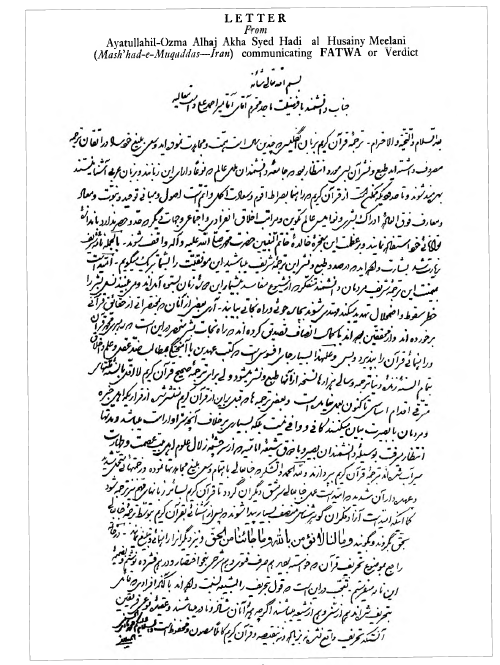
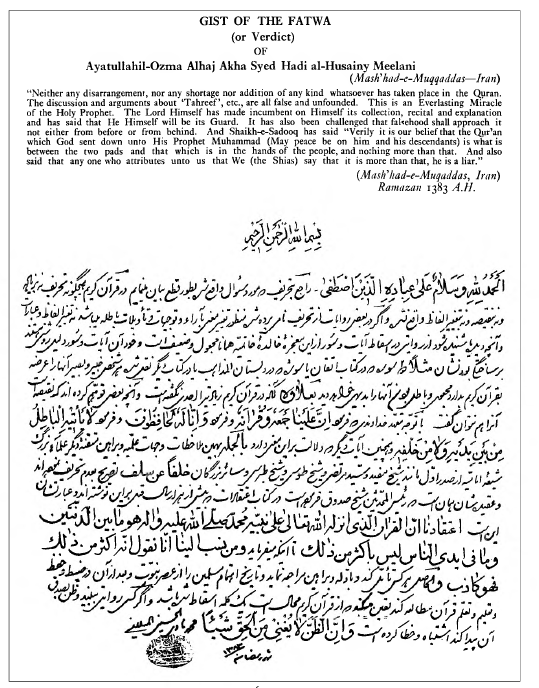

The Islamic Way Of Inviting Mankind To The Truth
The following verse of the Holy Qur’an lays down in clear cut words the only way or method through which mankind has to be invited to the Truth, i.e., Islam.
It is true that Islam was spread with the sword, but which sword, not the one the Christian Church used under the Edict of Milan against the poor and helpless jews, men and women and their innocent children, but with the sword of the ever triumphant Islamic ethics, enunciated through the ideal conduct and godly character of the Holy Prophet and the matchless sacrifices of the Holy Ahl Al-Bayt, which was surely the lovely heavenly weapon sharper and surer than the brutal one used in spreading the creed started in the name of Jesus.
The following is the Qur’anic injunction regarding the preaching of the faith by the Muslims:
ادْعُ إِلَىٰ سَبِيلِ رَبِّكَ بِالْحِكْمَةِ وَالْمَوْعِظَةِ الْحَسَنَةِ وَجَادِلْهُمْ بِالَّتِي هِيَ أَحْسَنُ إِنَّ رَبَّكَ هُوَ أَعْلَمُ بِمَنْ ضَلَّ عَنْ سَبِيلِهِ وَهُوَ أَعْلَمُ بِالْمُهْتَدِينَ
“And call thou unto the way of thy Lord with wisdom and kindly exhortation and dispute with them in the manner which is the best; Verily thy Lord knoweth better of him who hath gone astray from His path; and He knoweth best of those guided aright” (16:125).
Truth is that which even the enemy be helpless to vouch. Let the world listen to what the great Christian scholar declares:
“History makes it clear, however, that the legend of fanatical Muslims sweeping through the world and forcing Islam at the point of the sword upon the conquered races is one of the most fantastically absurd myths that historians have ever repeated”17
There are many more of such open declarations by the impartial scholars of the non- Muslim world, earnestly in search of the Truth. To quote all of them, will need a separate volume for itself.
What ‘Deen’ Or ‘Mazhab’ Actually Means
The Arabic term ‘‘Deen’ or ‘Maz’hab’ stands for the word ‘Religion’ in English and Religion means - “The human recognition of superhuman controlling power, especially of a personal God entitled to obedience, effect of such recognition on conduct and mental attitude” (OED)
Man by nature is self-conscious of an Absolute Authority of a Superpower of the highest order and the way he thinks and behaves in his desire to reach the authority or please that Power, is a religion. Islam as a religion stands for the divinely prescribed code of the method of disciplining the human Ego or self, in its practical life on earth, to enable man to raise himself from the abyss of the material degradation to the sublime spiritual heights of the eternal heavenly bliss, in store for those who successfully conquer the lust for material possessions and physical powers and restrain the passions for the fulfilment of the carnal desires.
Islam is a divinely formulated and perfectly regulated formula for leading the life with the purity of mind, sincerity in devotion and a faithful perseverance in the conduct or endeavour.
The Holy Qur’an gives the all-comprehensive formula in a few words of one single small verse or sentence of it:
قُلْ إِنَّ صَلَاتِي وَنُسُكِي وَمَحْيَايَ وَمَمَاتِي لِلَّهِ رَبِّ الْعَالَمِينَ
“Say thou (O’ Our Apostle Muhammad!) My Prayer, my Sacrifice, my Life, and my Death (are all, only) for God, the Lord of the worlds” (6:162).
It is worth imagining - if man ponders over the complete implication of this heavenly guiding note, in its fullness and acts upon it, how glorious the life on earth would be and there would be no need for man to aspire for Paradise, for the earth itself will become a replica of heaven.
This is the spirit and the aim of Islam. The Original Islam called ‘Shi’ism.’
How, Qur’an The Final Word Of God, Was Secured
It is a well-known historic fact that every religious scripture, revealed before the Holy Qur’an, has suffered unwarranted alterations, additions, and subtractions and some have even been made totally extinct. Leaving aside the ancient ones, take for instance, the case of Jesus the most recent one of the apostles of God, immediately preceding the Holy Prophet Muhammad. The ‘Injeel’ or the Evangel revealed to him, is totally extinct and not available to anyone today, and what is available today, is only the collection of the mere stories told by different persons at different times, based upon the contradictory and contested records of the Jewish folklore and even this has undergone and is still undergoing revision after revision, bringing forth variant versions of the text as well as the translation, hailed by some and contested by the others of the same church established in the name of the same apostle Jesus18.
This corruptive, disruptive, and the destructive activity on the part of man, was tolerated by the Almighty Providence as long as the scriptures which were tampered and corrupted, had not been finalised, and they were to go, to give place to the Final and an All-Comprehensive one which was yet to be given for the human race as a whole and for all times which was revealed to the Holy Prophet Muhammad the Last of the Messengers and warners from God. This Final Word of God, the Qur’an, was sent down with a challenging undertaking and assurance, that none thereafter shall ever be able to tamper it or meddle with it, as the Omnipotent Author or the Word and its Revealer Himself will take care of its Originality, Arrangement, Completeness and Security:
إِنَّا نَحْنُ نَزَّلْنَا الذِّكْرَ وَإِنَّا لَهُ لَحَافِظُونَ
“Verily We have sent down the Reminder (the Qur’an), and verily We (Ourself) unto it will certainly be the Guardian” (15:9)
“On Us is its (Qur’an’s) Compilation, its Recitation and its Explanation” Before leaving this world, the Holy Prophet declared:
“I leave among you Two great (very important) things, the Book of God and my Ahl Al-Bayt, should ye he attached to these Two, never, never shall ye gel astray, and verily never, never shall these Two he separated from one another”
This Apostolic announcement clearly declares that:
-
The Holy Qur’an was there in the form of a complete Book.
-
It was there in the hands of the people - for the Holy Prophet says, “I leave among or amidst you”
-
To avoid getting astray, people should hold fast to both, the Qur’an and the Ahl Al-Bayt and not the others.
-
The Ahl Al-Bayt will always be with the Qur’an, and Qur’an in its original form and with its correct meanings will be only with the Holy Ahl Al-Bayt.
-
As the Holy Prophet says, these Two will never be separated from each other, as long as Qur’an is there in this world, there will be one of the Ahl Al-Bayt (the Imam of the age).
The historic recital of Qur’an by the severed head of Husayn, the King of Martyrs, at Karbala, proved that a member of the Ahl Al-Bayt even when killed, is the custodian of the Qur’an and can deliver it to the world19.
Every Word Of The Holy Prophet Muhammad Was Nothing But The Revealed Word Of God
The Holy Prophet Muhammad spoke nothing but the revelation from the Lord. This unique character or the exclusive distinction of the Holy Prophet has been declared by the Holy Qur’an as well as the ancient scriptures:
وَمَا يَنْطِقُ عَنِ الْهَوَىٰ
“And nor he speaketh of (his own) inclination” (53:3).
إِنْ هُوَ إِلَّا وَحْيٌ يُوحَىٰ
“It (the wording) is naught, but a revelation revealed (unto him)” (53:4).
The Holy Prophet Has Been Identified As Such, Even In Ancient Scriptures
“For Moses truly said unto the fathers, a Prophet shall the Lord your God raise unto you of your brethren, like unto me; him shall ye hear in all things whatsoever he shall say unto you”
“And it shall come to pass, that every soul, which will not hear ‘that Prophet’, shall be destroyed from among the people” Old Testament - The Acts
“I will raise them up a Prophet from among their brethren, like unto thee, and will put my words in his mouth”, and he shall speak unto them all that I shall command him”
“And it shall come to pass, that whosoever will not hearken unto my words which he shall speak in my name, I will require it of him” Deut. 18/18, 19
“‘Howbeit, when the Spirit of Truth is come, he will guide you unto all truth for he shall not speak of himself but whatsoever he shall hear, that shall he speak; he will shew you things to come” New Testament - John 16/13
Islam - What It Means And Who Are The Muslims?
Islam literally means Surrender, Submission, i.e., The complete handing over of one’s self to another. Islam also means, Peace.
Islam as a religion, means an unconditional complete submission to the All-Supreme and the Absolute Sovereign authority of the Lord of the Universe. In other words, the total submission of the individual will to the Universal will of the Lord. One who does this, is a Muslim.
Once, one in fact does this, one’s individual will, ceases to operate and it becomes subject to the Universal will of the Lord. It is relating to this state of submission, the Holy Qur’an describes:
قُلْ إِنَّ صَلَاتِي وَنُسُكِي وَمَحْيَايَ وَمَمَاتِي لِلَّهِ رَبِّ الْعَالَمِينَ
“Say: Verily my prayer and my sacrifice, my life and my death, (are all, only) for God, the Lord of the worlds” (6:162).
إِنَّ الدِّينَ عِنْدَ اللَّهِ الْإِسْلَامُ وَمَا اخْتَلَفَ الَّذِينَ أُوتُوا الْكِتَابَ إِلَّا مِنْ بَعْدِ مَا جَاءَهُمُ الْعِلْمُ بَغْيًا بَيْنَهُمْ وَمَنْ يَكْفُرْ بِآيَاتِ اللَّهِ فَإِنَّ اللَّهَ سَرِيعُ الْحِسَابِ
“Verily the religion with God is Islam (submission to God’s will); and those whom the Book had been given did not differ but after the knowledge (of the Truth) had come unto them, out of envy among themselves; and whosoever disbelieveth in the signs of God, then, verily, God is quick in reckoning” (3:19).
بَلَىٰ مَنْ أَسْلَمَ وَجْهَهُ لِلَّهِ وَهُوَ مُحْسِنٌ فَلَهُ أَجْرُهُ عِنْدَ رَبِّهِ وَلَا خَوْفٌ عَلَيْهِمْ وَلَا هُمْ يَحْزَنُونَ
“Yea! Whosoever Submitteth his self (entirely) to God and is a doer of good, for him there shall be his reward with his Lord, on such shall be no fear, nor shall they grieve” (2:112).
وَمَنْ أَحْسَنُ دِينًا مِمَّنْ أَسْلَمَ وَجْهَهُ لِلَّهِ وَهُوَ مُحْسِنٌ وَاتَّبَعَ مِلَّةَ إِبْرَاهِيمَ حَنِيفًا وَاتَّخَذَ اللَّهُ إِبْرَاهِيمَ خَلِيلً
“And who is better in religion than he who resigneth himself entirely unto God? and is righteous, and followeth the creed of Abraham, the Upright One, And God took Abraham for a Friend” (4:125).
What is demanded of a human being, or that which is acceptable to God, is nothing short of Islam:
الْيَوْمَ أَكْمَلْتُ لَكُمْ دِينَكُمْ وَأَتْمَمْتُ عَلَيْكُمْ نِعْمَتِي وَرَضِيتُ لَكُمُ الْإِسْلَامَ دِينًا
“This day have I perfected for you, your religion, and have completed My favour on you, and chosen for you Islam (to be) the Religion” (5:3).
The following verse gives the last word on the choice of a religion for mankind:
وَمَنْ يَبْتَغِ غَيْرَ الْإِسْلَامِ دِينًا فَلَنْ يُقْبَلَ مِنْهُ وَهُوَ فِي الْآخِرَةِ مِنَ الْخَاسِرِينَ
“And whosoever seeketh any religion other than Islam (total resignation unto God) never shall it be accepted front hint, and in the next world he shall be among the losers” (3:85).
- 1. Vide 16:98; 7:204.
- 2. Vide 22:52-54.
- 3. Vide am.The Encyclopedia of Islam.
- 4. Viz. the Case of Fadak.
- 5. Haqq al-Yaqeen.
- 6. Vide 2:124.
- 7. Vide 58:11.
- 8. Vide 2:282.
- 9. Vide 3:144.
- 10. Vide 4:165.
- 11. Vide 81:8.
- 12. Vide 91:8.
- 13. Vide 15:9, 41:42.
- 14. Ref. introduction of Al-Kafi, Vol. 1.
- 15. Wafi - closing Chapter on Qur’an.
- 16. As stated by Mustafa Sadiqe-Rufaa’yee in his Book ‘Ejaazul Qur’an’.
- 17. De Lacy O’Leary, in his famous work Islam at the Crossroads. London, 1923, p. 8.
- 18. Vide the Dua of the Catholic Church, the St. James Edition of the Protestant Church and the Diaglott of the Watch Tower Society Etc.
- 19. See the detailed note on Tahrif by A.P.
