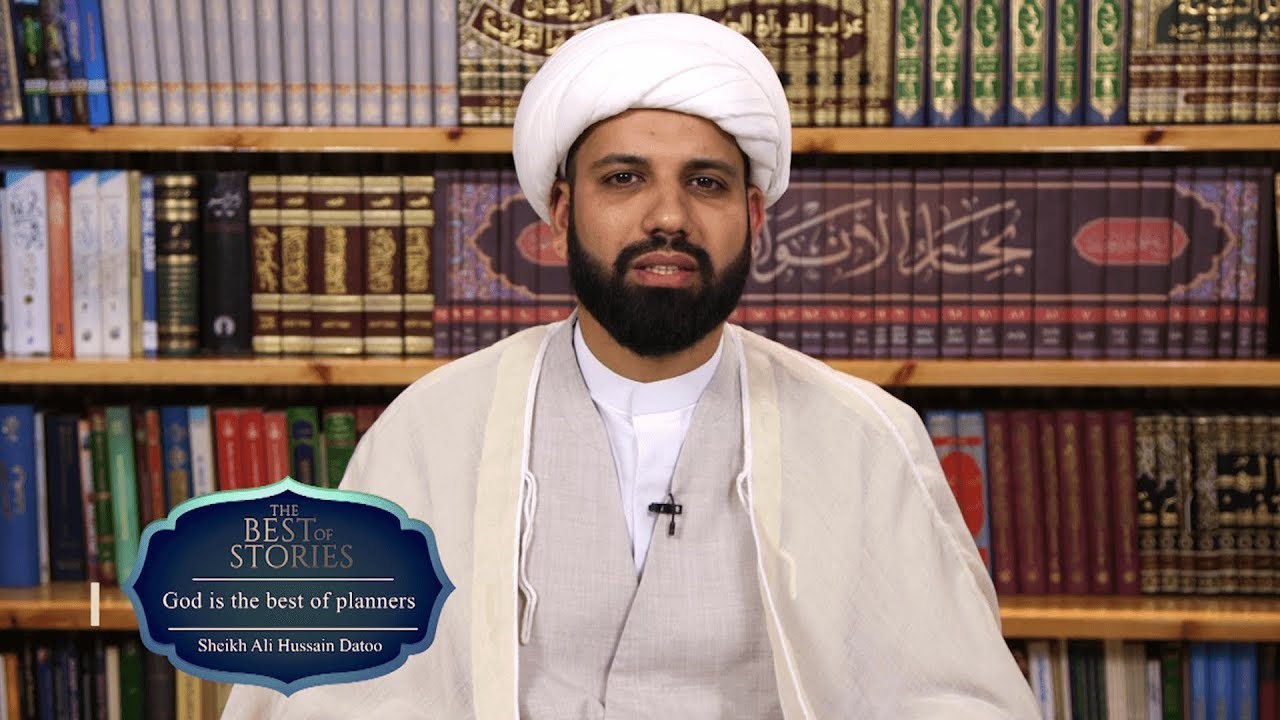
Surah Yusuf (12) - The Best Of Stories 11/15

"Nahnu naqussu 'alayka ahsan al-qasasi bimaaa awhainaaa ilayka haadha al-Qur'an"(12:3) "We do relate unto thee [Muhammad] the most beautiful of stories, in that We reveal to thee this (portion of the) Qur'an".
A'udhu billahi, as-samee', al 'aleem, min al-shaytan al-la'een al-rajim. Bismillah, al-Rahman, al-Rahim. Al-hamdulillahi rabb il-'alameen, thumma as-salaat wa as-salaam 'ala sayyiddina Muhammad wa 'ala ahli baytihi at-tayyibeen at-tahireen. Allahumma salli 'ala Muhammadin wa aali Muhammad. Dear viewers, Salamun alaykum jamee'an wa rahmatullahi wa barakatuh.
In these episodes that we have been discussing, we have looked at the chapter of Yusuf. We have looked at principles of morality, which we have been able to extrapolate from this Surah, from the story, which is the longest chronological story mentioned in one chapter in the Holy Qur'an.
We are looking at how Allah Subhana wa Ta'ala is taking care of Yusuf, of how Yusuf is relying upon Allah at every step of the way, how he has no one else to rely upon, and how Allah is unfolding His plan, Using the plan of others Allah is unfolding His own plan.
We have also been looking at the emphasis that the Ahlu Bayt, alayhum assalam, have placed on reciting and contemplating on the Qur'an, without this Book, you and I would have no guidance.
The Ahlul Bayt alayhum assalam, have emphasized continuously how to recite the Qur'an, when to recite the Qur'an, how we should sit when recite the Qur'an, that the fact that we should even have a good fragrance from our mouth when we should recite the Qur'an. There are etiquettes that have been mentioned with regards to reciting the Holy Qur'an. One of the etiquettes that I would like to touch upon in this episode is the etiquette of reciting the Qur'an in a beautiful voice.
The Holy Prophet mentions this as one of the requirements, one of the etiquettes- when somebody recites the Holy Qur'an. When we think about a good voice, what may come to our minds is moving in high and low rhythmic fashion, to move your voice in such a manner in which you are singing the holy Qur'an or reciting it in a melodious tone. Rather the Ahlul Bayt, alayhum assalam, have a different take on it. The Ahlul Bayt, the Prophet peace be upon him says that, "The best of voices is that voice that when you hear it, you understand that it fears Allah Subhana wa Ta'ala."
That when an individual comes across a verse of Heaven, he becomes ecstatic about it, and when he comes across a verse of Hell, you can tell by his voice that is fearful of Hell, or she is fearful of Hell. When this individual comes across verses that increase their hope in Allah Subhana wa Ta'ala, you should tell from their voice, you can tell from the complexion on their face, their expression on their face, that this individual understands what they are saying and is trying to make this Qur'an a part and parcel of them, he is trying to mix it with their flesh and with their blood.
Of course, this is not possible without understanding the Qur'an and knowing its meaning. And that is why many a time in these episodes we have continuously encouraged that you and I should go back to learning this language if we have not done so. If we do not know this language, then we should try and exert effort in understanding. There are so many available courses to learn Arabic, they are online, they are at people's houses, they are in our mosques.
We can not neglect it, we should not have a reason not to learn at least words from this language. You know, so many words in the Qur'an are repeated. That if every day we learn five words, ten words from the Holy Qur'an, within a few months we will know a lot of the Qur'an will understand. Yes, we will not know the grammar, yes, we will not know the nuances that are mentioned inside. But at least we will know more than we did when we started off. This will only bring about a greater taste and sweetness when we begin to recite the Qur'an.
In our discussion in Surat Yusuf, we have come to the stage where we see that Yusuf is being taken care of by Allah Subhana wa Ta'ala (12:25-29)when he came to the door and the door flung open, he saw that Aziz was standing there. A child from the family of Zulaykha was there as well, and the child spoke out. And because of the child's confession, because of the child's statement, Yusuf was no longer seen as the perpetrator of a crime, but rather was seen as the victim.
Word gets out to the chief ladies of the town that this is what has happened to the wife of the Aziz and now they are concerned and they want to see, what is it? What is it that is infatuated with the wife of the Aziz, the wife of the Aziz herself?
Zulaykha does not want her reputation to be ruined, so what she does is that she brings about a conducive environment for these ladies, she calls the ladies to the palace. They come to the palace and she gives each of them a fruit and a knife in their hands. She asks them to cut the fruit and at the same time, she calls Yusuf out. As Yusuf comes out and they see the beauty of this man, "wa qulna haasha li-Llah, maa haadha basharan, in haadha illaa malakun karim"(12:31)- "They say, glory be to Allah, they say this is not a human, this is not a man, this is not a being, this must be an angel. It is impossible that such beauty can be given to a human being."
Initially, it was just Zulaykha that wanted to seduce Yusuf, only Zulaykha wanted to commit a crime after the women who were laughing at Zulaykha actually saw Yusuf themselves, they too, became individuals who fell at the feet of Yusuf. They, too, became infatuated with Yusuf.
Zulaykha says, this is what you were taunting me about, this is what you were accusing me of, this individual.(12:32) Yes, it Is true, I tried to seduce him, 'fasta'sam'. It is very important to understand, in verse 32, Zulaykha herself admits, confesses, and she says 'fasta'sam'- that he kept away from me. He protected himself, the same root that we use for 'Ismah'- A-sa-ma. He has protected himself from me, that means he did not even incline towards her.
If he inclined, if he took a step and then changed his mind and ran away Zulaykha would not have said that he protected himself. She would not have used such a strong word to say that he completely distanced himself from me. It was me who was trying to seduce him and he kept himself away from me.
Then Zulaykha says, "..now, if he does not do what we command him to do, what I am commanding him to do, then we shall put him in prison.(12:32) " So now she she gives Yusuf an option, either you do what we command you to do or we put you in prison at this time.
Now, it is not just Zulaykha who is trying to commit this heinous act. It is Zulaykha as well as the rest of the women, all of them are trying to corner Yusuf. And this is one use of comes out with this profound statement and it says, 'qaala Rabbi, as-sijnu ahabbu illayya mim-maa yad'unani ilayh'(12:33)- "Oh, my lord, prison is more beloved to me as a result compared to what they are calling me to."
On one side, they are calling me to this act, on the other, they are telling me that I can go to prison. Some have misunderstood this and they have said that Yusuf is asking Allah to put him in prison. Yusuf is not doing du'a that O Allah put me in prison, he is telling God that, God, these are the two options that they have given me. One is that right now I do what they ask of me, and that brings about Your displeasure, which is not possible for me to do. The other one is for me to accept to go into prison but in going into prison, I do not bring about Your displeasure. I bring about Your pleasure because I am not doing the other act. For this reason, Yusuf says that, "Oh, my Lord, going to prison is more beloved to me than doing what they would like me to do"(12:33).
So Allah Subhana wa Ta'ala removes their plot because Yusuf continues in this verse and he says, " wa in-laa tasrif anni kaydahunna'(12:33) - and If O Allah, if you do not remove the plots and the trickery and the plans for me, I fear that I might fall into their actions when I am unaware, not intentionally. Maybe I am trying to run away from the room, and now they have cornered me and they are physically more than me so maybe they will be able to attack me. Maybe I might fall into that sin because of them attacking me. O Allah, I do not want that to happen. So remove these plans and trickery from them and I prefer prison. This is a proof to me all that I prefer even prison compared to doing something that will bring about Your displeasure.
Sometimes people cannot understand it, why is it that a man would prefer to waste his life in prison compared to doing some action and then forgetting about it and at least he will be a free man?
Amir ul-Mu'minin 'alayhi assalaam, in Nahj-ul-Balaaghah, in the sermon of Hammam, sermon of the Muttaqin as it is famously known, he says a beautiful sentence he says ' fal-muttaquna fiha' the God-wary individuals-the individuals who are conscious about God in this dunya, 'hum ahlul-fadaa'il'-'they are people of distinction, they are people of merit,' no one can match them, they stand above the rest, they shine out you can tell that these people have merit, they place God on a pedestal, they prioritize God over everything else. Imam continues and he says, 'azam-ul-Khaliqu fi anfusihim' - 'They have given God the greatest seat in their hearts', 'fa saghura maa dunahu fi a'yunihim'- 'So everything else in their eyes has become belittled and become petty.'
When you place God in your heart and you give Him the greatest of stations and seats in your heart, that everything else is petty to you, nothing else matters. Prison,so let it be, so long as my Lord's pleasure is in prison, then I shall go to prison.
That is why Amir ul-Mu'minin 'alayhi assalam says,'That even if you put me in hellfire, it is not the Hellfire that I am worried about, It is not the pain of the Hellfire. The pain that is going to kill me is separation from you, oh my Lord. Hellfire or Heaven, What is the difference? I want to go to that place where You are present, I want to go to that place where Your proximity is present. I want to go to that place where I can see You and I can witness You and I can love You and I can taste this love, that, of course, is Paradise.
There are people who are fallible, who have got to a station where the Prophet said about them, 'innal jannata li-s-Salmaan ashwaq min Salmaan ila-l-jannah'-'That heaven was yearning for Salmaan to enter it more than Salmaan was yearning to enter into Heaven.' Heaven does not become their goal anymore, Paradise is not their goal, the pleasure of Allah is their goal, wherever the pleasure of Allah lies that is where they shall begin to run.
We know that Allah Subhana wa Ta'ala will only test us in accordance with our capability when we read this chapter of Yusuf and we see the test after test that he is going in, we should not think that Allah will do this to everybody that He loves, No, Allah will test those that He loves so that He can purify their hearts and cleanse that love to make it a sincere love that has no ulterior motives.
Just like when you want to purify gold. When gold is mined, it has to go through an intense heat process so that it can be melted, the dirt can go away and pure gold can remain. In the same way a believer's heart is tested by all to their capacity and capability.
It would be unjust of Allah to test you in a manner which you would not have the capability to pass that test. He will only test you with those tests that you are able to pass, that He has given you the potential and the tools to pass this test. So when we see these great tests that are coming about on Yusuf, we should immediately conclude that his capacity, his vessel was so great that he could take these tests and with every test that he passed, Allah increased his station and gave him something greater.
Allah mentions in the Qur'an that 'We send down rain'- 'fasaalat awdiyatun bi qadariha' (13:17) -'We send down rain and then the rain flows in the valleys according to the capacity of the valleys.' The larger the valley, the more rain can gush forth.
The Prophet peace be upon him had the greatest vessel, his test were the greatest of tests. Our great our tests are petty in comparison to his, but our tests are great in comparison to our capacity. We are tested by our capacity and so every test that comes before you, you have the choice of complaining about it or you have the choice of saying Allah, thank you for testing me, because through this test I will be able to achieve a greater station.
We ask Allah Subhana wa Ta'ala in this holy month of Ramadan to make us individuals who will become so steadfast that when He tests us, we do not complain, rather, we thank Him and we seek for His protection, His ability, His tawfiq that He should give us that we can pass these tests with flying colors.
We should never turn to Allah and ask Allah, Why did You choose me? Rather, we should turn to Allah and say thank You for finding me worthy of this test and help me to pass them with Your pleasure.
Wa sall-Allahu 'ala Muhammad wa 'ala ahli baytihi, at-tayyibeen, at-tahireen.